What will a low-barrier shelter mean to Fort Wayne’s unhoused population?
City officials say a 24/7 shelter will offer programming, safe parking, and other amenities that will help people in need.
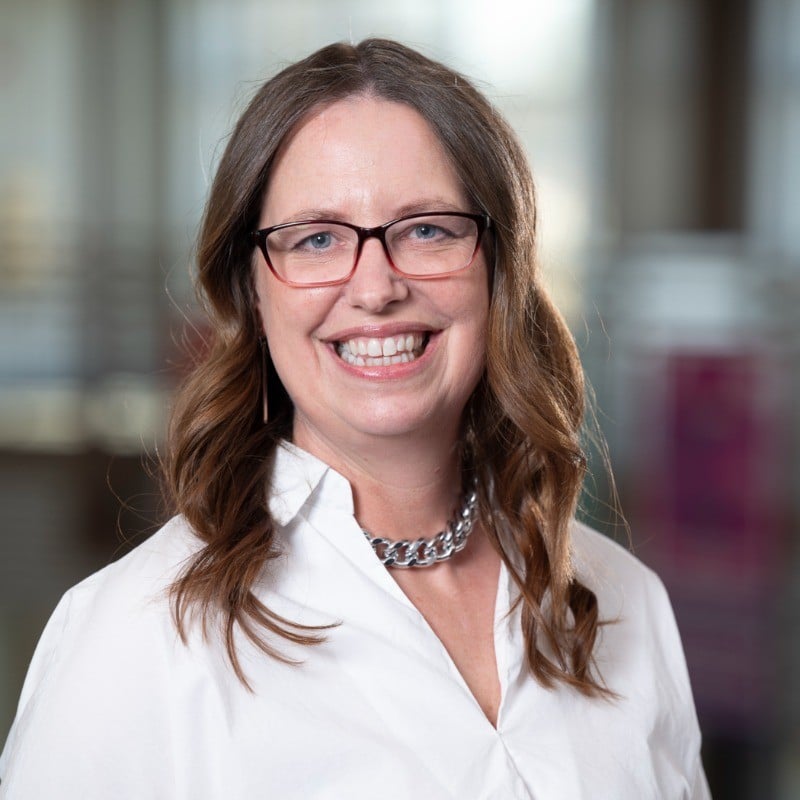
Over the last few years, the city of Fort Wayne has taken significant steps forward in its approach to homelessness, marked by a multi-pronged approach. Last spring, the city introduced its first Community Development Manager for Homeless Services, Amanda Fall. More recently, the city’s Office of Housing & Neighborhood Services announced it’s reviewing proposals from qualified nonprofit organizations to operate a new, low-barrier homeless resource center.
According to city officials, these initiatives aim to provide 24/7 access to essential amenities and support services, while addressing critical gaps in the current system. The homeless resource center, a key component of the city’s “Everyone Home” community plan, is designed to create a more comprehensive and effective response to the needs of the unhoused population.
According to data cited by the Office of Housing & Neighborhood Services, an unofficial 2025 count identified 253 unsheltered individuals, 40 households in hotels, and 47 households living in vehicles, with shelters operating at over 80% capacity (462 people sheltered). Approximately half of the individuals affected declined to provide full information, suggesting undercounting.
“Despite strong local providers, the community lacks a 24/7 low-barrier access point where individuals can consistently meet basic needs and engage with services,” says Mary Tyndall, the office’s public information officer. “This gap slows housing placements and increases reliance on emergency systems.”
Further compounding the issue is the fact that while Fort Wayne has several day shelters and drop-in centers, none offer round-the-clock services. Existing facilities have limited hours, varying resources, and barriers to admission. All of this creates a patchwork of support that can be difficult for unhoused people to navigate.
“We definitely have some day shelters in town… but none of them are open 24/7,” Community Development Manager for Homeless Services Amanda Fall says. “There isn’t any place where people can get showers [after a certain hour].”
Erin Ness is the executive director of St. Joseph Missions, a Fort Wayne-based shelter for single women. She underscores the urgency of the moment.
“Shelters are just really busting at their seams. I mean, we’re full all the time,” she says. “It will get people off the street, in someplace warm.”
A defining feature of the planned center is its low-barrier model. This approach removes many of the typical requirements for entry, welcoming anyone who wants to work toward finding housing.
“By this being low-barrier — not having really any requirements to come in other than that you want to work on getting housing — it will welcome everyone to come in and start their path,” Fall says.
Though this model would be new to Fort Wayne, it’s not a novel concept in the broader conversation around homelessness nationwide.
In Boston, as a response to the number of unsheltered people and those experiencing substance use disorders (SUD) living in an encampment, the city established six harm reduction low-threshold shelter (LTS) sites in January 2022. The Boston Health Commission tracked results via a point-in-time survey. The assessment indicated that 72% to 90% of survey participants reported improvements in sleep quality, food security, and connection with others since moving into LTS.
In other words, a new center in Fort Wayne could help people focus on their well-being and stability because their basic needs are taken care of. This is a crucial distinction that community partners like St. Joseph Missions believe will make a tangible difference.
“Having it be a low barrier is huge,” Ness says. “People [might not] want to go to the shelters, because…there are rules and regulations… but really, low barrier is what we’re really lacking.”
The 24/7 accessibility is another unique aspect. It provides a safe place for individuals regardless of the time of day, including those who work second or third shifts and need access to services outside of typical business hours. This will also offer police a reliable place to bring individuals in need at any hour.
A related program, safe parking, will offer designated parking spaces for people living in their vehicles. This is based on the idea that unhoused people living in their vehicles should have designated, legal, and supervised places to park overnight and access basic supports. According to the Colorado Safe Parking Initiative, one hallmark of this approach is that parking sites are “typically located in existing parking lots and only occupied during hours when they are otherwise unused, such as faith organization facility parking or businesses.” It does not replace permanent housing or other types of temporary housing, but it reduces the risk of harm by helping people to stay safe while on the path to stable housing.
According to Fall, the city is drawing inspiration from successful models in other cities, such as LTHC’s shelter in Lafayette, Indiana. She believes their model is within reach for communities like Fort Wayne. Among its strengths, she says its 24/7 accessibility and co‑located practical amenities (like showers, mail, lockers, laundry, etc.) are effective ways to help the unhoused community. It also boasts a safe parking program, clear operations and documentation, robust partner coordination, and replicable logistical design.
Like LTHC, Fall says Fort Wayne’s plan also includes services like mail access and storage lockers, vital elements for individuals trying to manage their lives without a permanent address. The goal is to find a location that is centrally located and accessible, as transportation is a significant barrier for many.
Last fall, the city issued a Request for Proposal (RFP) to identify a nonprofit partner to operate the center. Per Tyndall, “the City will examine the following when selecting a nonprofit organization to operate a low-barrier shelter: organizational experience with unhoused individuals, capacity of the organization, program design, collaboration with other agencies, and budget.”
The city’s role will be to acquire and prepare a building, while the chosen non-profit operator will manage daily operations, staffing, and long-term fundraising. Speaking of funding, Tyndall says the city is aligning with a non-profit entity because the city has access to limited federal housing funds. These dollars can be used to leverage private funds to support this model. Additionally, the city considers the community’s network of nonprofit agencies to be the experts on homelessness. In Tyndall’s words, “They have the expertise and understanding of how to walk alongside individuals on their journey to stability.”
However, the nonprofit at the helm won’t be going it alone, at least not in the early stages. The city aims to secure enough community support and partnerships to cover operations for the first 2–3 years. According to Tyndall, after this initial period, the nonprofit would be self-sufficient and operate independently, with a board of directors overseeing the mission of the nonprofit.
As far as holding the nonprofit accountable for its end of the bargain, the city will have a mechanism in place.
“As long as the City owns the building, the lease could stipulate that it be operated as a low-barrier shelter,” Tyndall explains.
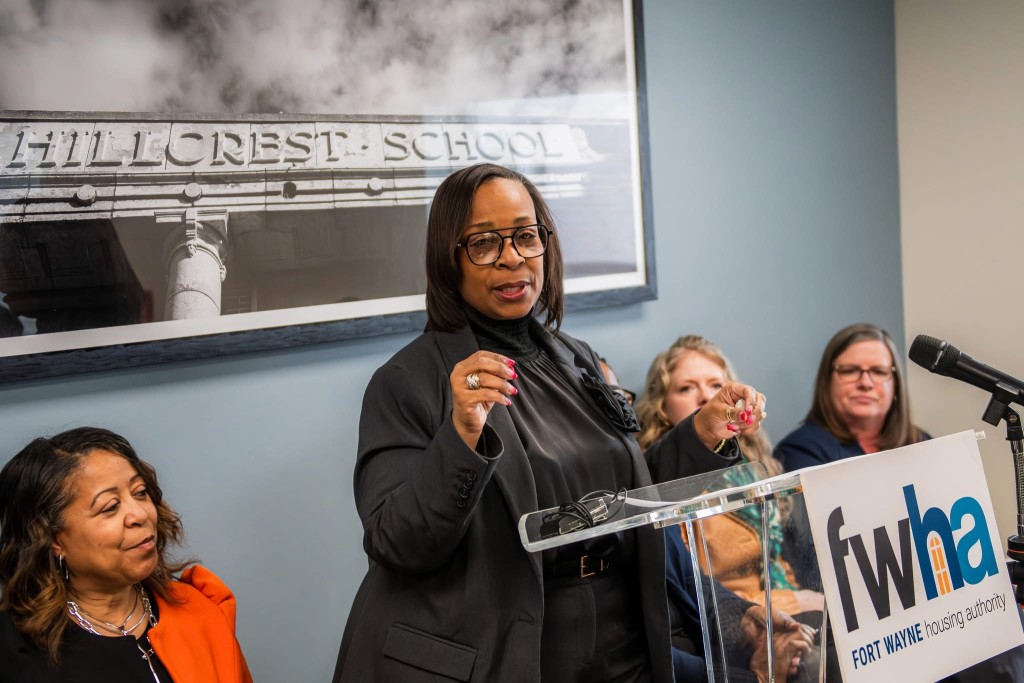
This center is not seen as a singular solution, but as a vital piece of a larger, multi-faceted strategy. It complements other efforts, like the development of permanent supportive housing and programs aimed at preventing homelessness in the first place. For example, the city recently partnered with the Fort Wayne Housing Authority on the newly opened Hillcrest Commons, a new permanent supportive housing development catering to adults experiencing chronic homelessness.
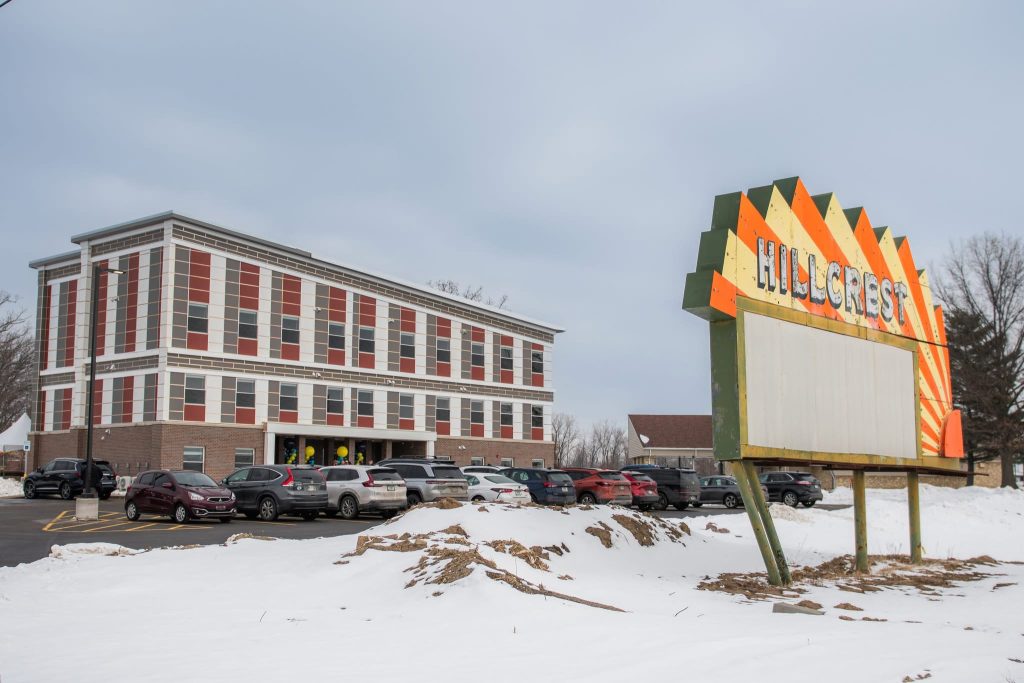
“The [homeless resource center] is one piece of really everything that we’re working on,” Kelly Lundberg, deputy director of the Office of Housing and Neighborhood Services, explains. “We know that it’s really important to keep people housed who are at risk of becoming homeless.”
As Tyndall explains, prevention offers a pragmatic path forward to addressing this complex issue.
“If we can keep families and individuals housed by providing rental or other assistance, this keeps them out of shelters and prevents them from eviction when the challenges become even more difficult and costly to address,” she says.
The center’s impact will be measured not just by the number of people who find permanent housing, but by the small victories along the way.
“Success isn’t always getting someone in a home,” Fall says. “You’ve got to celebrate the small successes first.”
These wins include connecting someone to mental health counseling, medical care, or substance use treatment.
As the city moves forward with selecting a location and an operating partner, the general mood of the community’s social service providers is optimistic. According to Ness, the new resource center represents a forward-thinking investment in the well-being of all residents.
“We’re excited for this new shelter,” she says. “We want to be good community partners and look to definitely support that shelter.”
Sally Segerson, a grassroots activist and founder of Street Reach for the Homeless, also supports the low-barrier shelter. As she points out, mental health challenges and substance use disorders prevent many of the city’s unhoused population from qualifying for local shelters’ services and securing long-term housing and/or employment.
She equates introducing a low-barrier shelter to the city with “dipping a toe in the water” and challenges officials to think more long-term and comprehensively.
“This is the first [low-barrier shelter in Fort Wayne], but the question becomes: tell me what’s next,” she says. “Start looking for more grants. Start being proactive for that second one, because my opinion is this one is reactive.”
This discussion comes at a time when SB 285, a bill that would create a new Class C misdemeanor for sleeping outside, passed the Indiana Senate in early February. It’s scheduled for a hearing in the House of Representatives Courts & Criminal Code Committee next week.
Author

Related Articles
How a statewide grant program supports the arts in rural communities
The Indiana Arts Commission (IAC) funds arts and cultural initiatives in rural counties that, in turn, support community, economic, and tourism goals.
Partner Partner Content How Visit Wabash County Strengthens Community, Economy, and Quality of Life
Visit Wabash County drives community pride, economic vitality, and storytelling across the county.
Planting seeds for a greener future: Huntington celebrates ‘Oaktober’ with new city forester
For the first annual Oaktober, Huntington planted 500 trees across the town to boost its urban forest.