A downtown grocery store & more: How urban markets are reemerging in Fort Wayne
Three new urban markets are rising in Fort Wayne.
Kirk Moriarty walks into a conference room at Greater Fort Wayne Inc. and sits down excitedly, clasping his hands and leaning forward.
As Director of Downtown and Urban Development in Allen County, he’s Fort Wayne’s “go-to grocery guy,” and while the demand for a downtown grocery store has been growing for about 10 years now, it seems the pot is finally boiling over.
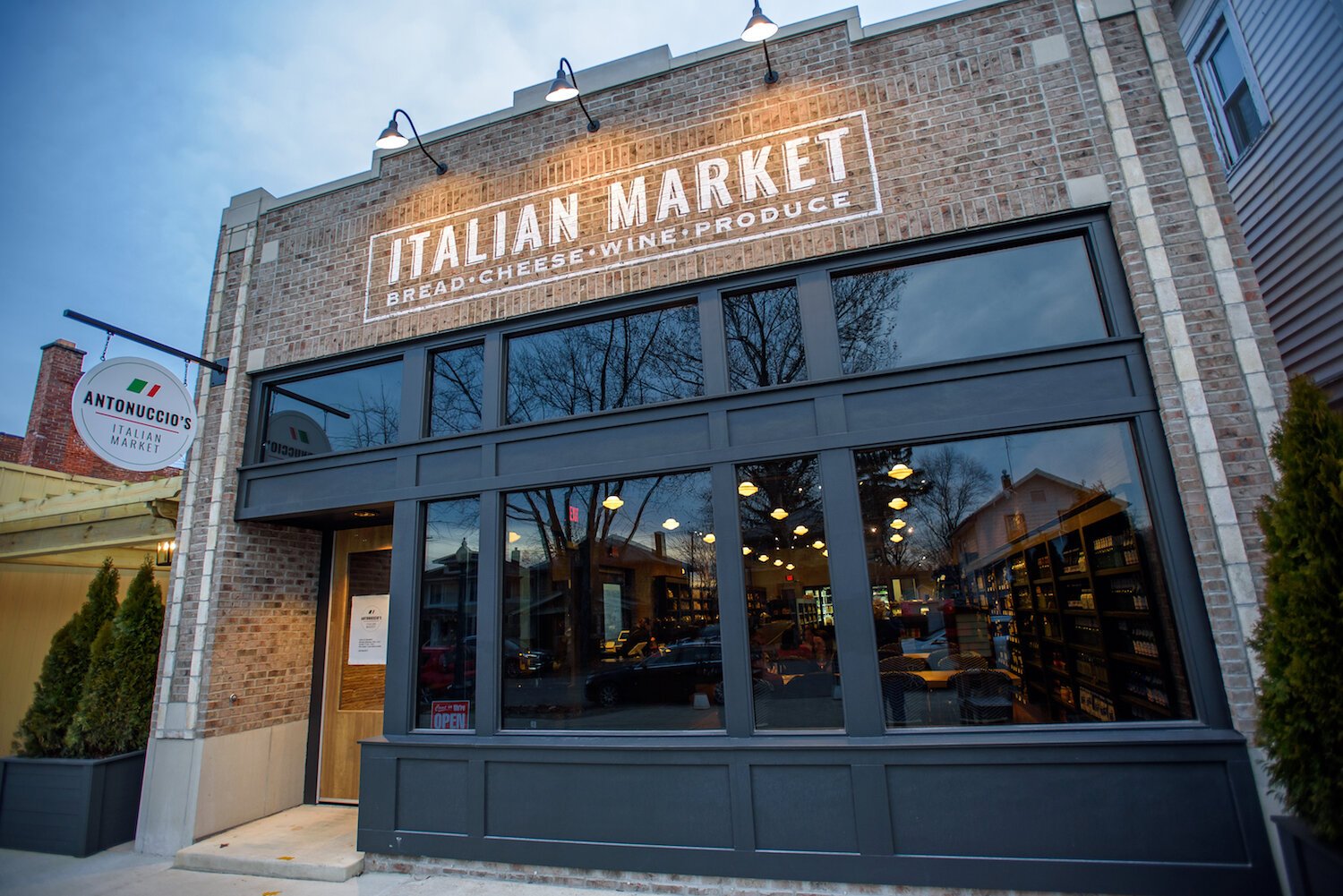
In the past three months, three small, locally owned grocery stores have either opened or been announced in locations around Fort Wayne’s urban core. In late-October, the city saw plans for a healthy grocery store downtown. In November, Antonuccio’s Italian Market opened on the south side of town, and plans for the Utopian Community Grocery in Southeast Fort Wayne were announced later that month.
Moriarty suggests there’s more news on the way.
“By the end of 2020, you may have more than one market downtown,” he says.
So what’s driving the reemergence of urban markets in Fort Wayne, and how will they fare against their big box store competition?
A few decades ago, the city was home to a number of locally owned grocery stores: Scott’s Food Stores, Rogers Markets, and Maloley Food Stores, to name a few. These stores eventually closed or were bought out by national chains, like Kroger. Since then, local favorites like George’s International Market and the 3 Rivers Food Co-Op have carved out a niche for themselves.
Now, as the grocery industry evolves with the digital age and more consumers opt for urban lifestyles, a new generation of innovative, local markets is emerging.
This trend is not unique to Fort Wayne. Across the country, grocery store openings are spiking, with small stores leading the way. The JLL 2019 Grocery Tracker report attributes the change to shoppers preferring short, frequent trips to the grocery store for items needed each day, likely driven by a renewed interest in downtown living.
“Such trips are best served by smaller stores,” the report notes. “Grocers are responding by building smaller stores and focusing on local offerings.”
As more small, urban markets open in Fort Wayne, the challenge for these retailers, Moriarty says, will be making themselves sustainable and ideally profitable.
“You’re talking 1 to 3 percentage points of profit as the industry standard for grocery stores,” he explains.
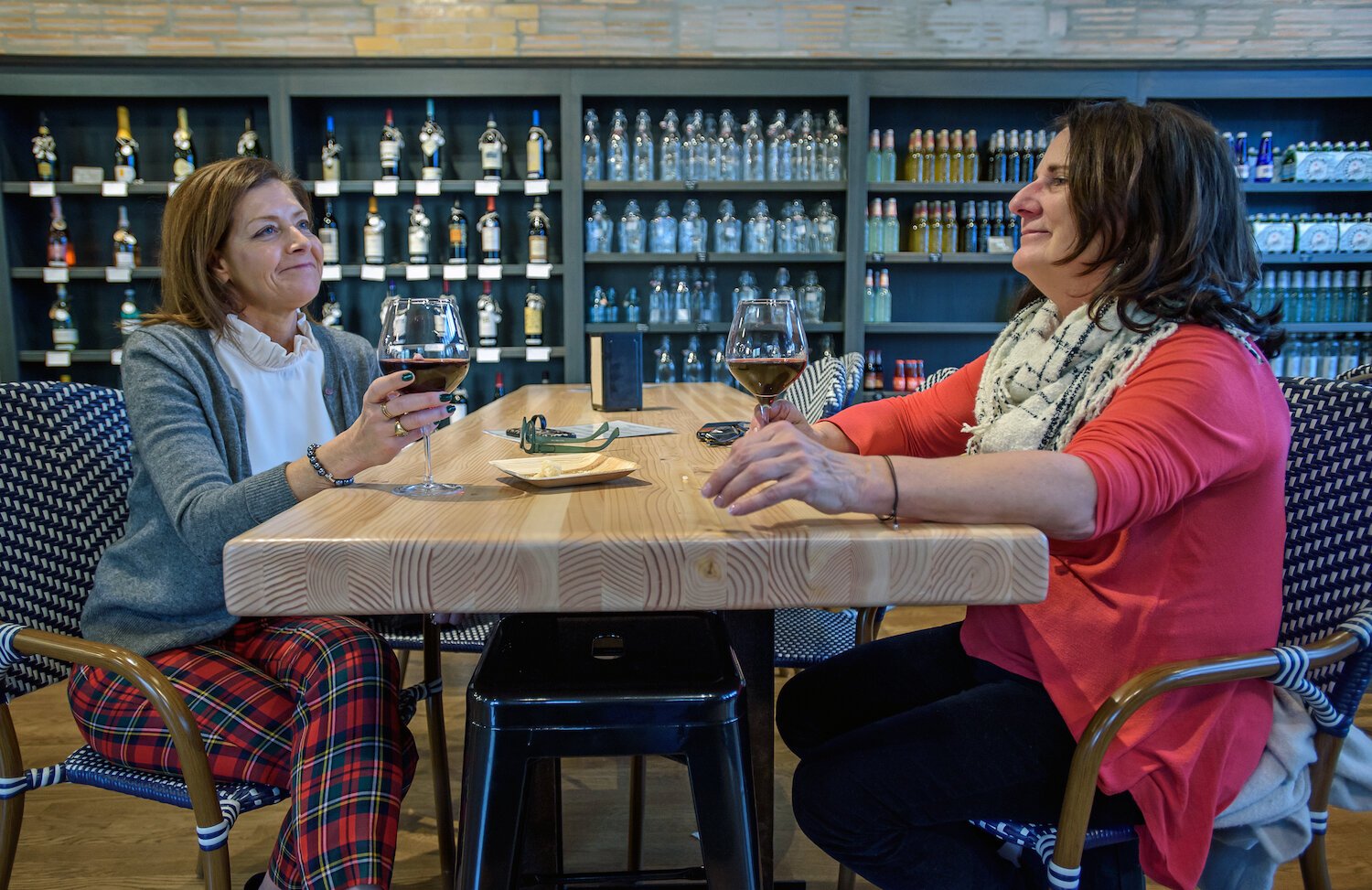
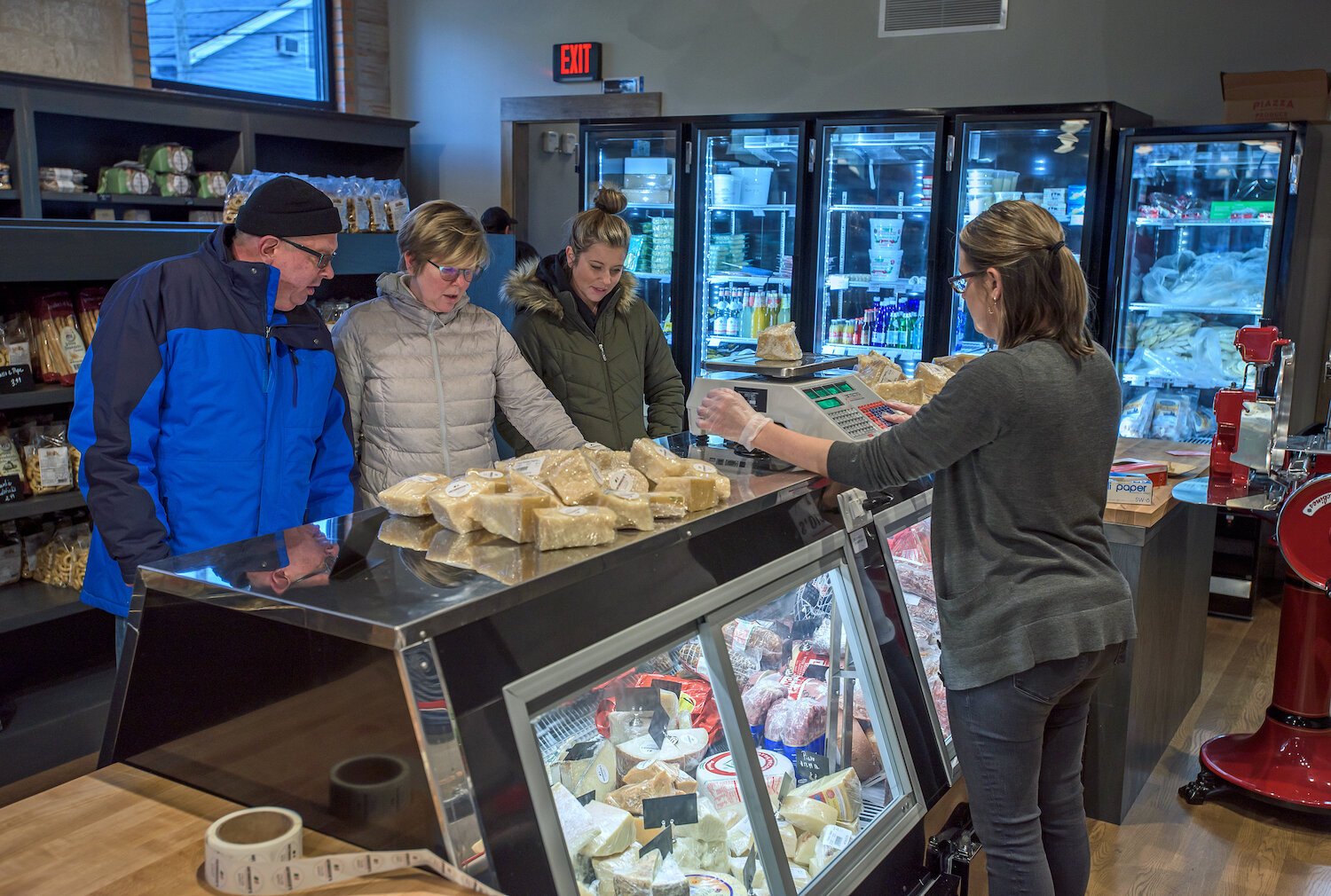
With this in mind, many local markets are diversifying their offerings. Antonuccio’s, for example, doubles as a deli and wine bar.
The downtown and Southeast grocery stores are developing unique business models, too. More than that, they’re working to bring healthy, affordable options to areas of low food access in Fort Wayne to improve the city’s equity and health outcomes.
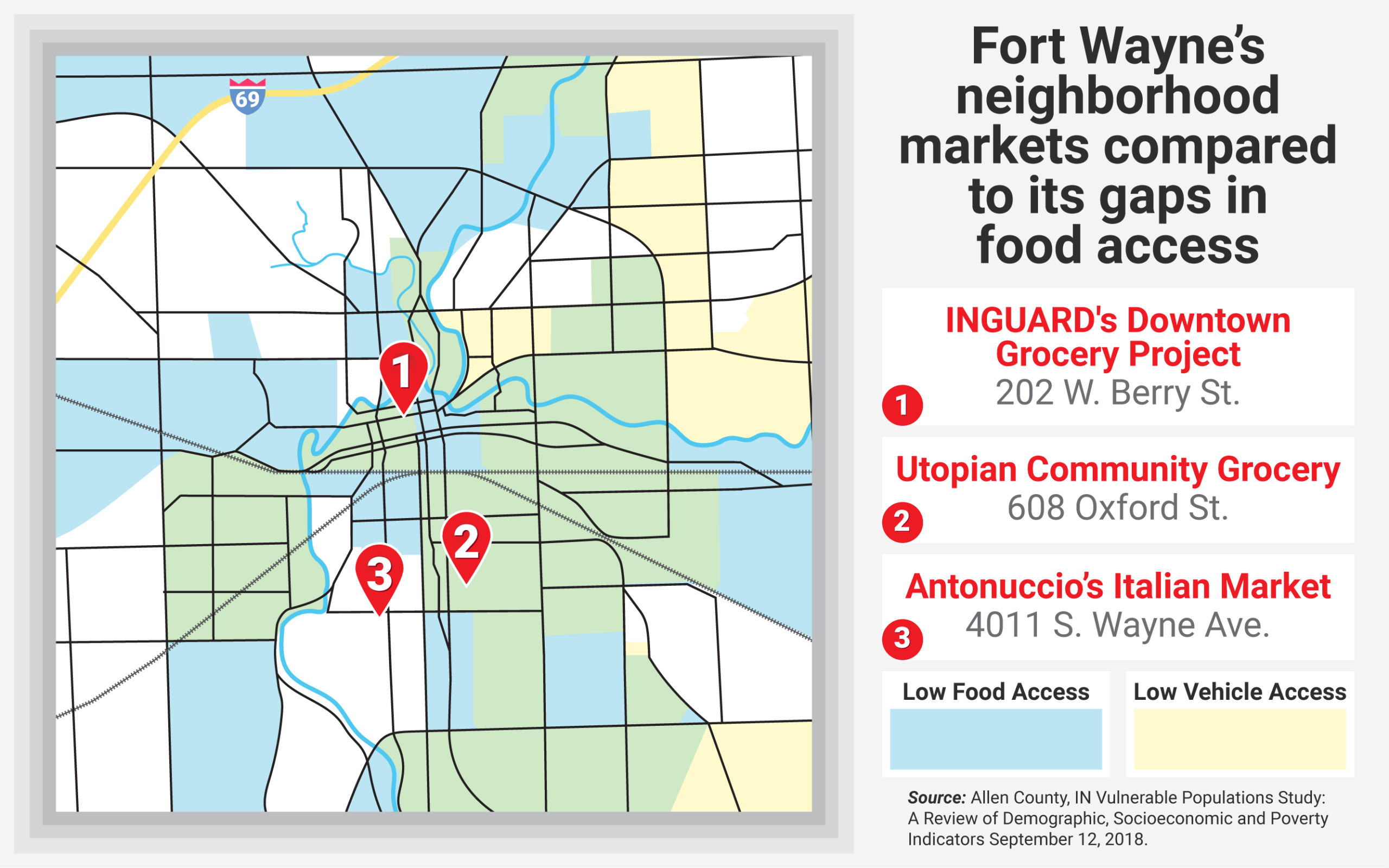
Here’s what they have in mind.
The Downtown Grocery Store
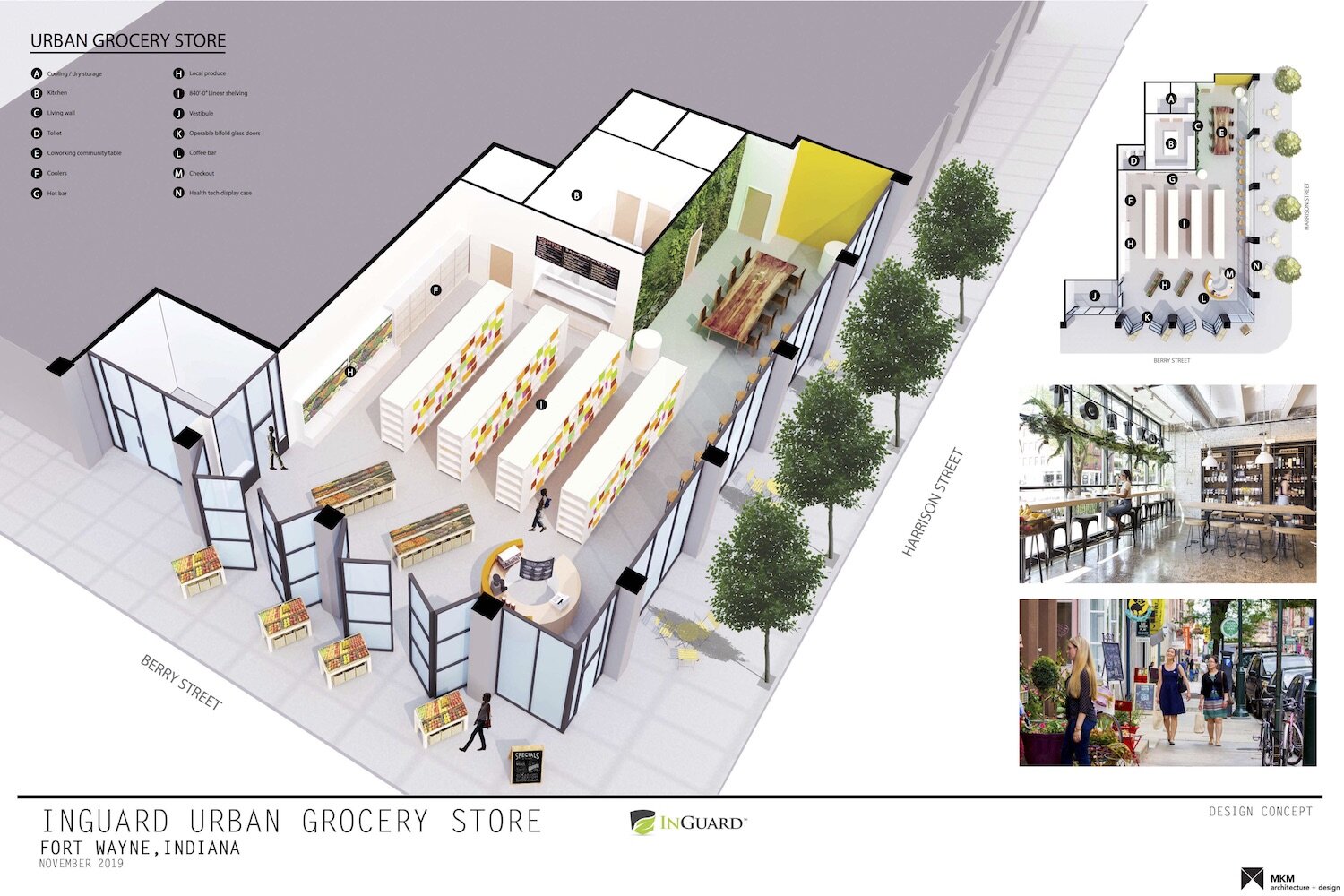
In late-October, several local news organizations reported that INGUARD, an insurance company based in Wabash, Ind., is planning to open a healthy grocery store in downtown Fort Wayne in 2020.
What wasn’t initially clear was what type of grocery store it would be. While early announcements referred to the project as the “Fit Grocer,” due to INGUARD’s partnership with Fitbit, that title is somewhat misleading, says INGUARD CEO Parker Beauchamp.
To help his clients reduce the cost of their health insurance, INGUARD has a partnership with Fitbit through its wellness plan, which “gamifies” health in rewards and competitions, Beauchamp explains.
Even so, the grocery store he envisions for downtown Fort Wayne is more focused on improving health outcomes community-wide, he says. That means it will be welcoming and open to everyone—regardless of whether they are INGUARD clients or Fitbit users.
“It’s a super simple concept; it’s a grocery store,” Beauchamp says. “INGUARD’s wellness and insurance clients will have some special ways to participate in the store, but at the end of the day it’s just a grocery store.”
Beauchamp envisions the project as a locally owned downtown shopping experience with affordability, accessibility, and health-outcomes at heart, and he assures residents that food will be sold at an inclusive range of price points.
That’s part of INGUARD’s mission of “unlocking healthy food for everyone.”
“We consider food that makes you feel good, food for all,” Beauchamp says.
So why is an insurance company in Wabash investing in an urban market in Fort Wayne?
It all started with a grocery store in Wabash, and Beauchamp’s desire to promote healthier communities region-wide through INGUARD’s work.
Growing up in Wabash, about 50 miles southwest of Fort Wayne, Beauchamp is a fifth-generation insurance professional who literally dreamt of being an insurance broker as a kid.
Now that he’s living the dream, he’s finding unconventional ways to advance his company and give back to his community at the same time.
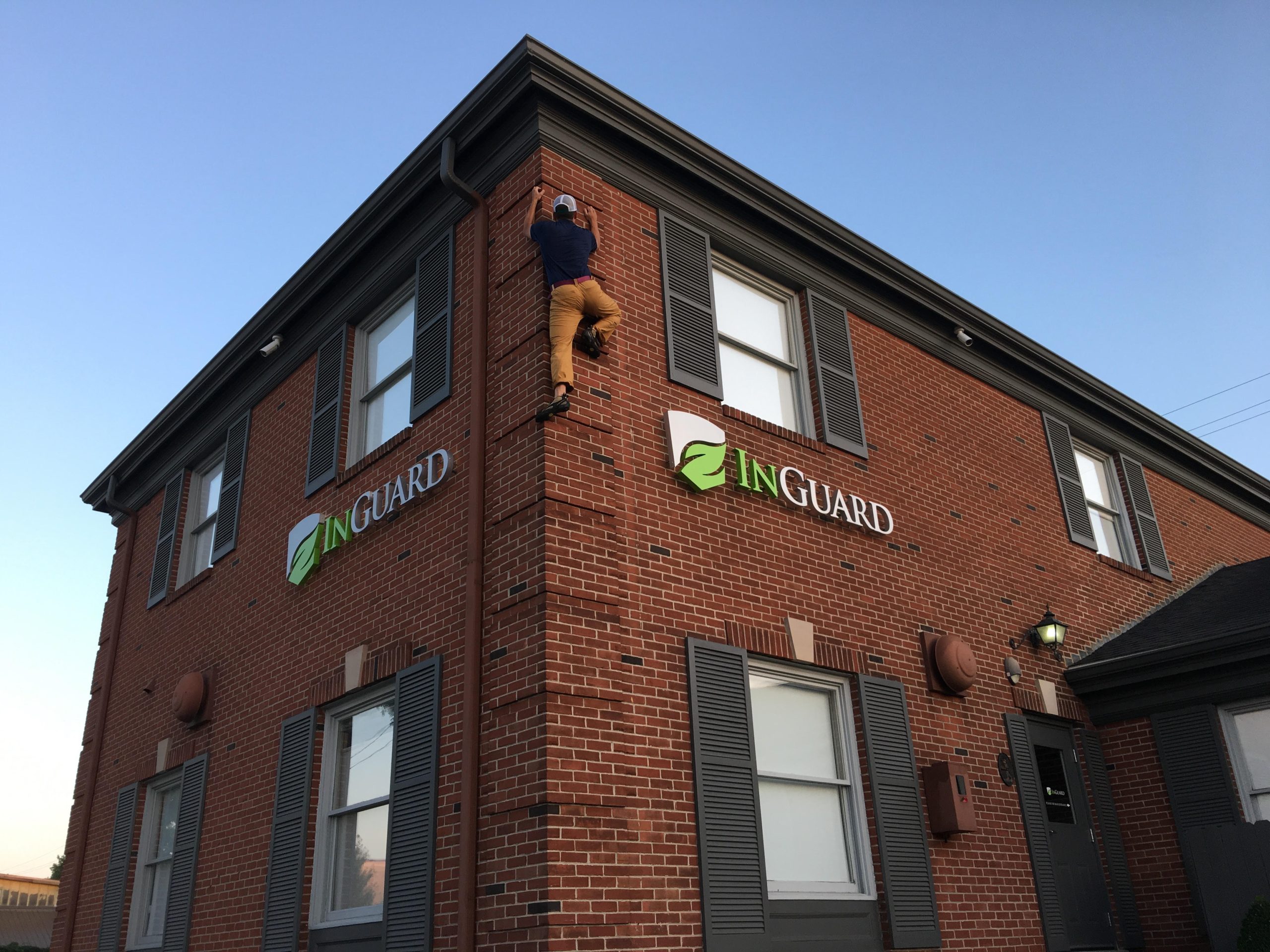
A few years ago, he helped save and renovate Wabash’s iconic 13-24 Drive In theater. Since then, he’s opened Innovate @ INGUARD, a 100 percent free, 24/7/365 coworking space for experimenters, pioneers, and big thinkers.
So when the opportunity arose to acquire a healthy grocery store in Wabash, he was eager to jump on it for a number of reasons.

For the second consecutive year in 2019, INGUARD has been named the Healthiest Employer in Indiana—and the 11th healthiest in the U.S.—by healthiestemployers.com. Its team of about 50 employees, many of whom are based in northeast Indiana, keep active and shop at the local health food store in Wabash, Beauchamp says.
Along with supporting his employees’ interests, owning a grocery store presented him with a unique opportunity: A way to address the root cause of costly health insurance for INGUARD’s corporate clients.
“We know that most of our clients have a huge problem with their health insurance because they have self-funded plans, and their employees are unhealthy,” Beauchamp says. “Most of the time, they end up footing the bills from healthcare providers.”
He wondered: What if there was a way to help employees have fewer healthcare bills to begin with? That’s why INGUARD Health is reverse engineering its clients’ employee benefits plans to put health at the forefront, and that means getting into the food industry was essentially unavoidable, Beauchamp says.
“When it comes to health, we know it comes down to three little things: It’s what you eat; it’s what you eat; and it’s what you eat,” he explains. “Any kind of effort that doesn’t include food is not going to win.”
Even so, changing people’s eating habits is challenging—particularly when healthy food is not as accessible or affordable as fast food. Hence, the need for more nutritious grocery stores in Indiana cities.
“We’re trying to get people to choose health over healthcare,” Beauchamp says. “Ultimately, we want to make the best choice, the easiest choice, and therefore, people don’t have to go to the doctor as often.”
So INGUARD became the first insurance company (to his knowledge) to own a grocery store. The goal is to inspire a paradigm shift in health, “away from costly procedures that could have been prevented and towards preventative measures, like access to healthy food, that infuse vitality into our communities,” its website says.
It’s about addressing the root causes of issues in cities and acknowledging that everything connects.
Now that INGUARD’s Wabash grocery store has been successful for more than a year, it’s taking the concept to the next level.
Along with moving its current grocery store to downtown Wabash in 2020, it’s partnering with Ash Brokerage in Fort Wayne to open a second location in 3,000 sq. ft. of ground-level retail space at the Metro building on the corner of Harrison and Berry Streets.
Beauchamp envisions additional locations across northeast Indiana, too. He also wants to open micro-stores he calls “HealthQuarters” within his clients’ corporate headquarters, which will function as “tech-driven pop-up stores where food will be delivered and picked up from,” he writes in an open letter.
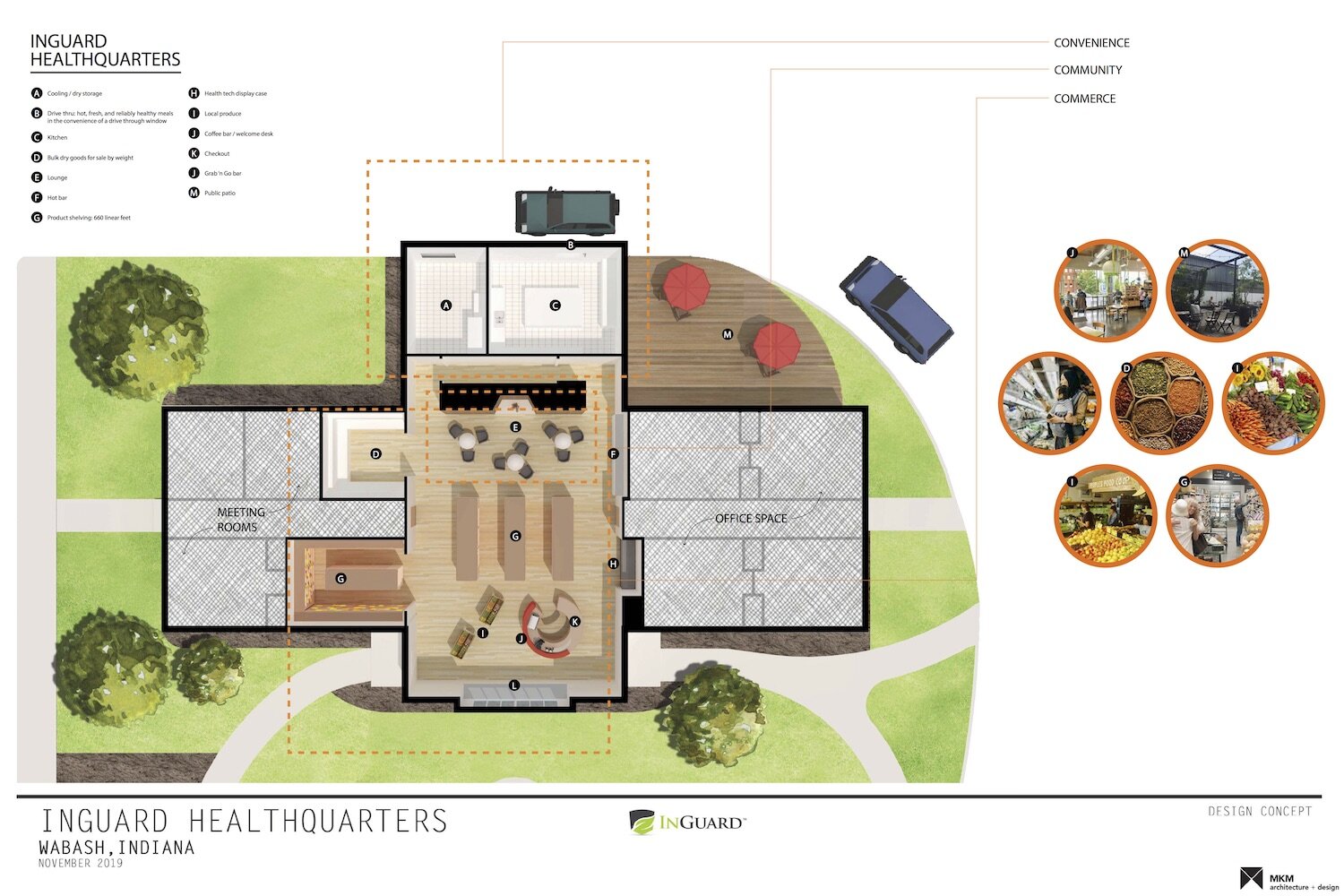
Speaking of delivery and pick up service, INGUARD’s yet-to-be-named grocery store in Fort Wayne has the potential to be game-changing for the way the city eats. The grocery will offer delivery service to some employers and residents of downtown with pickup service available to everyone.
Plans call for fresh, locally grown produce, grab-and-go meal options, and concepts like a kombucha and smoothie bar. Studies are currently underway to determine which amenities will best serve the downtown community, Beauchamp says. Renderings of the future store are already available on INGUARD’s website, and subject to change, he notes.
As for what’s inspiring him to invest in Fort Wayne, of all places, he says he and his wife both do business in the city every week, and they know that the vitality of Fort Wayne ultimately determines the success of the entire region, including their Wabash home.
“We truly want the best for one of the unhealthiest parts of the country,” Beauchamp says. “We’re not doing this to make money; we’re doing this to help northeast Indiana.”
That’s a good thing, too, says Sherry Early-Aden, Vice President of Operations of Brightpoint in downtown Fort Wayne.
As a nonprofit, Brightpoint helps individuals, families, and communities address the root causes and conditions of poverty in Allen County, and one roadblock it’s identified in Fort Wayne’s community is the lack of affordable, healthy grocery options downtown.
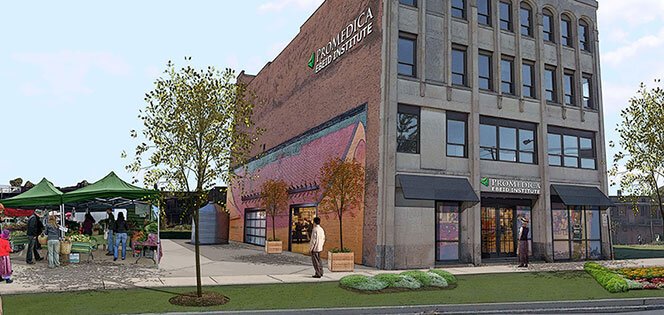
So for a few years now, Brightpoint has been working with consultants at ProMedica in Toledo to open a small, inclusive urban grocery store to serve its downtown Fort Wayne clientele and neighbors.
ProMedica helped launch a similar store, Market on the Green, in one of Toledo’s most economically depressed areas, Early-Aden says. Since then, the store has drawn customers from across the city, creating a dynamic space where people of all income levels shop together.
Even so, the challenge is making small grocery stores sustainable, Early-Aden says. Market on the Green has been operating for about five years now, and they’re just this year breaking even on the project, she adds.
If an urban market is going to be successful in Fort Wayne, it has to be focused on community impact in the long run over making a quick return on investment.
“If there was a ton of money to be made doing this, we wouldn’t need to be having this conversation,” Early-Aden says. “The Krogers of the world would be coming downtown. But the larger corporations have recognized that it would probably be a really hard task to make a profit in downtown Fort Wayne right now. That’s why you see local people like ourselves and INGUARD stepping up and saying, ‘We’re willing to take a chance on our community because it’s where we live and where we love.’ It’s not just the bottom line for us.”
Brightpoint and INGUARD are currently communicating and working to do what’s best for all members of the Fort Wayne community, Early-Aden says, whether that results in multiple markets or a combined effort.
On the Southeast side of town, another team is coming together to address Fort Wayne’s food deserts.
The Southeast Grocery Store
If you ask Ty Simmons, opening a grocery store in Southeast Fort Wayne has always been the end goal.
Simmons grew up on the city’s Southeast side and graduated from South Side High School. He remembers the area being underprivileged compared to other parts of town.
When he left Fort Wayne to earn his degree at San Francisco State University, much of Fort Wayne evolved with renewed investment and downtown development. But what surprised Simmons when he came back was that Southeast was pretty much the same.
“It hasn’t changed,” Simmons says. “There’s no grocery store and not many businesses here are owned by people who live in the community.”
Instead, much of the 46803 and 46806 zip codes are classified as food deserts, or places home to at least 500 people that are more than one mile from a supermarket or large grocery store, according to the United States Department of Agriculture.
Since the Southeast side of Fort Wayne was redlined as part of the New Deal, it has had a hard time recovering and attracting sustainable investment. What’s worse, Simmons says, is that gas stations, fast food chains, and convenience stores have stepped in to fill the gap instead of community-advancing developments.
“A lot of these convenience stores just draw money from the community by putting band-aids on problems—and actually worsening problems here—because they sell food with high fructose corn syrup and high fat,” he says. “It’s also consumer manipulation because their products are also twice as expensive as they would be at Kroger or Walmart, and they know they have a captive consumer audience.”
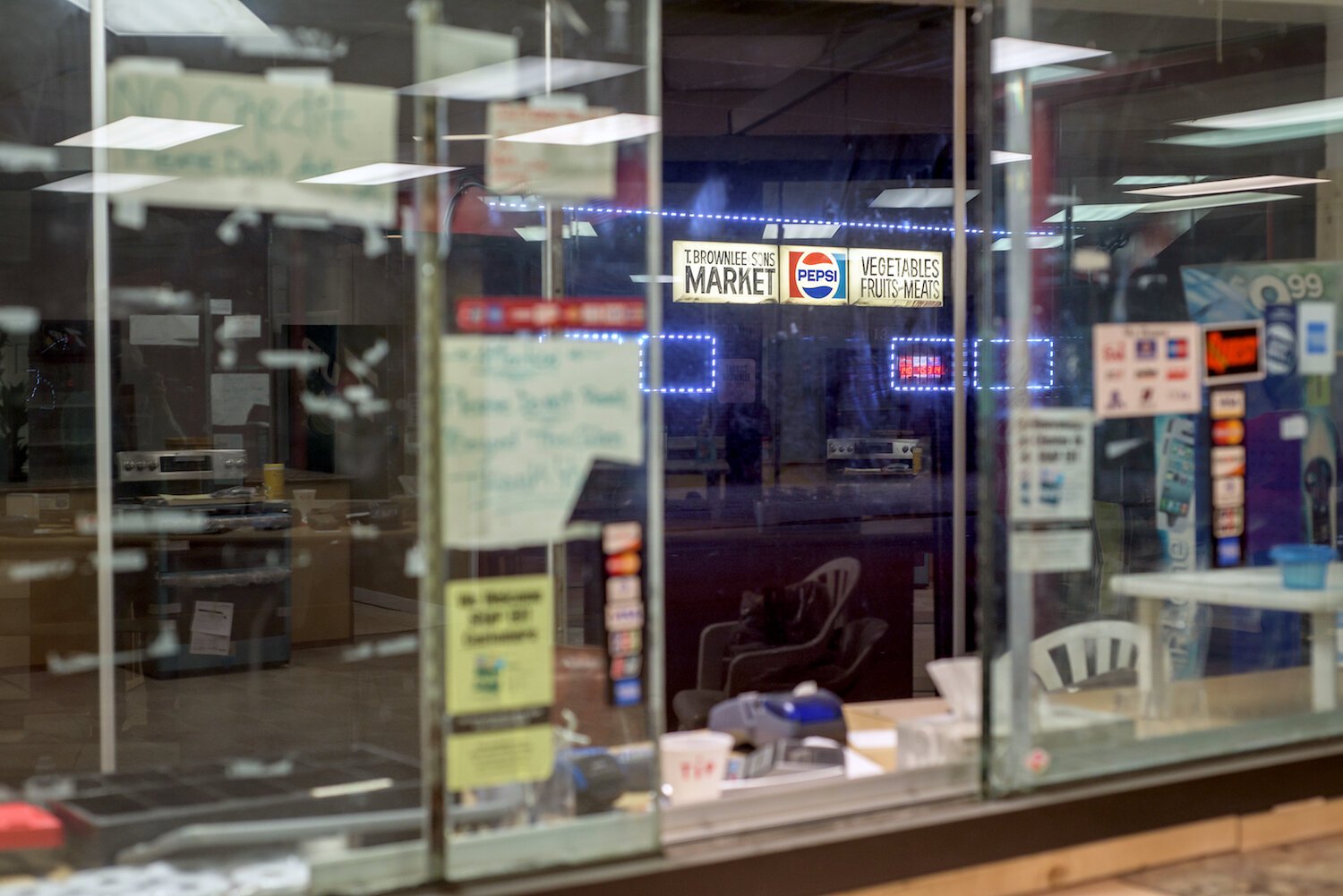
Since many Southeast Fort Wayne residents do not have access to personal vehicles, they’re forced to buy food close to home wherever they can find it. Even if they do drive to the nearest Walmart or Kroger, those national chains don’t carry as healthy or as many products in their south side stores as they do in other local stores, Simmons adds.
With this in mind, he and a group of concerned Fort Wayne residents of all ages, races, and backgrounds have come together to make a difference.
They call themselves the Human Agricultural Cooperative, and they started about three years ago, investing in 15 youth from the Fort Wayne Urban League, teaching them how to grow healthy food in Southeast community gardens.
Over the years, the nonprofit cooperative has certified 25 youth farmers and donated more than 3,000 lbs. of food to their Southeast neighbors, Simmons says. Now, they want to take their efforts to the next level.
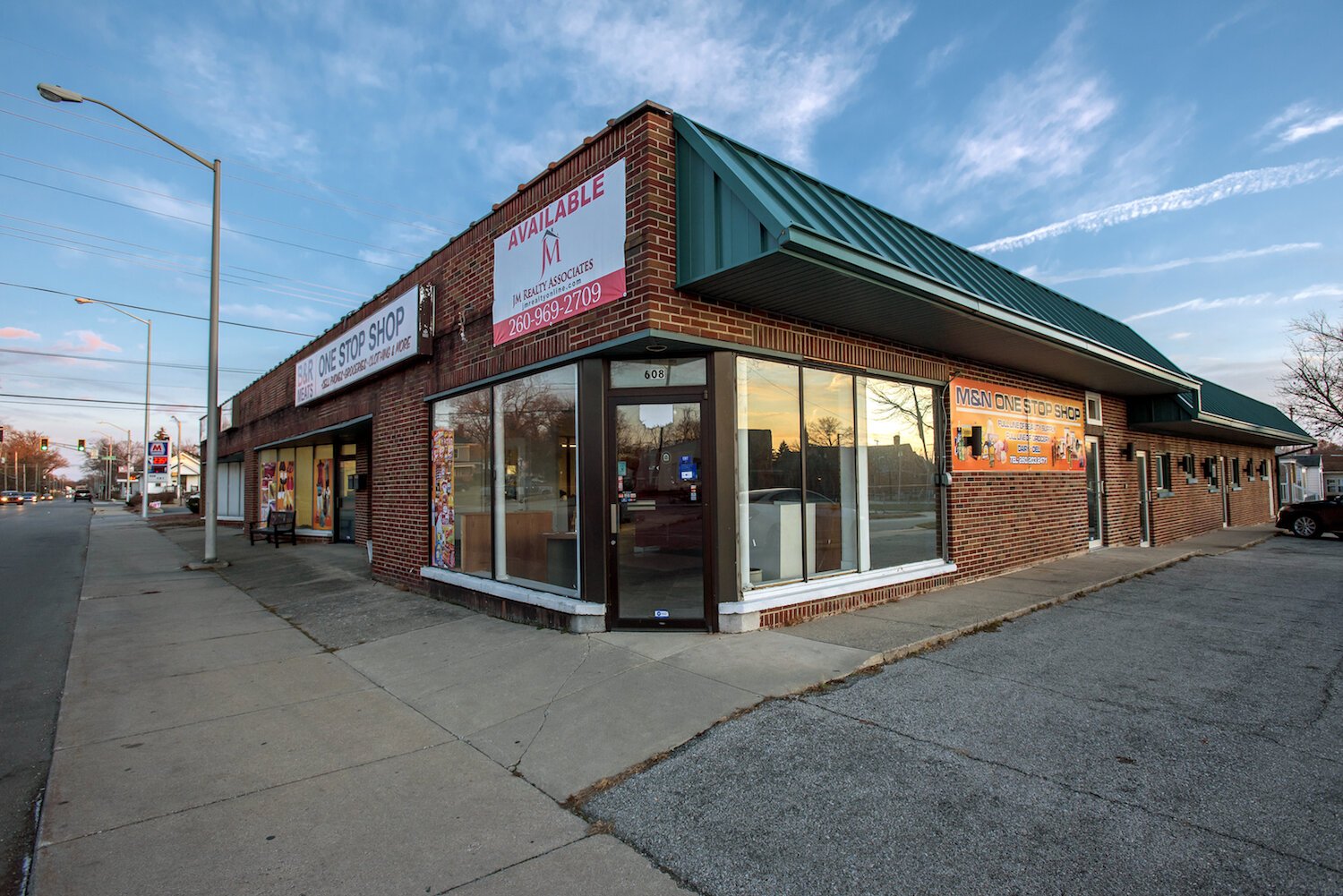
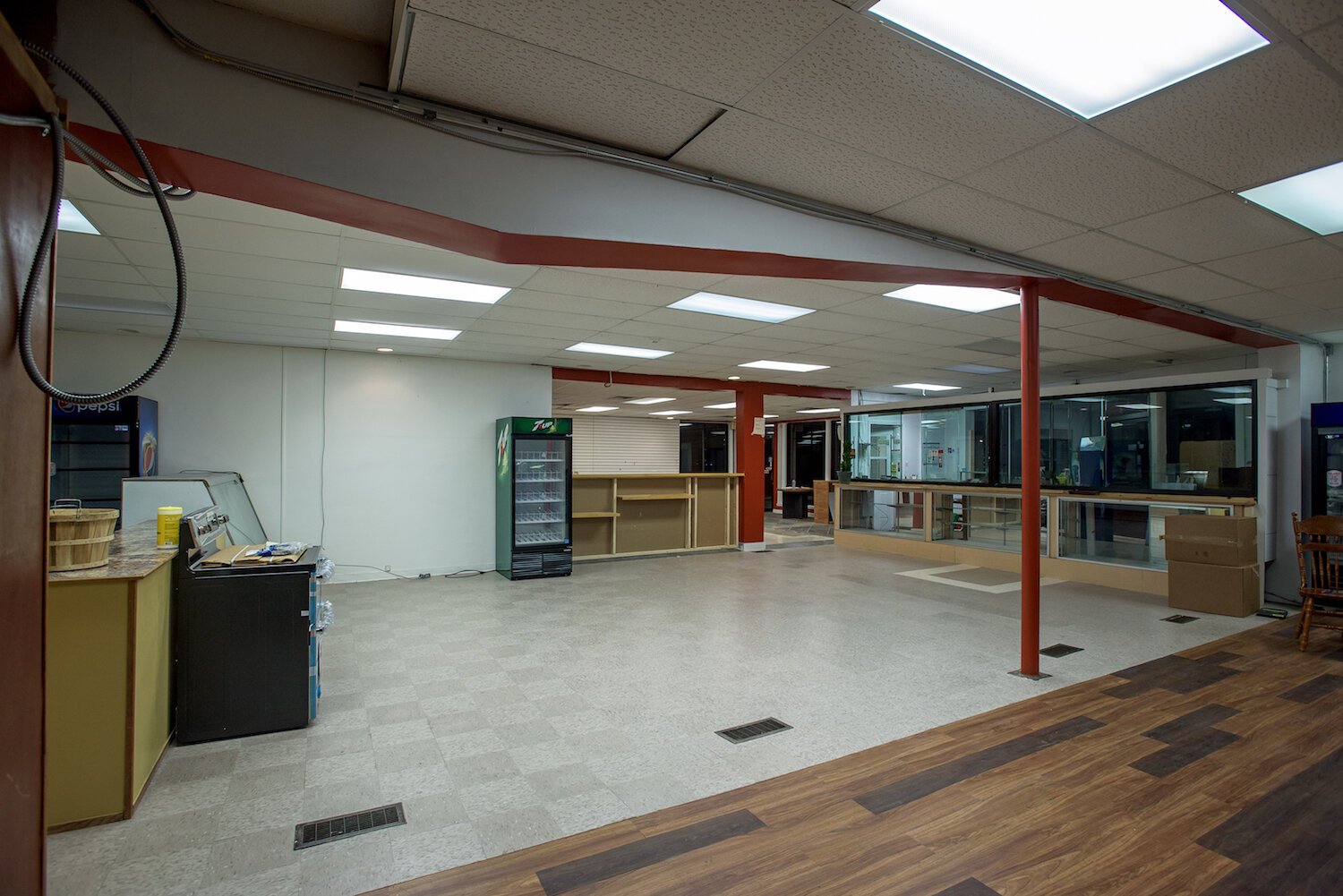
In September, they acquired an abandoned meat market at 608 Oxford St., which they’re converting into the first official HANDS Center. HANDS stands for everything they’re about: Hope Arts Networking Diversity and Service.
Along with providing a safe space for neighbors to meet and hangout, the HANDS Center will be a mixed-use development, home to a fresh food grocery store, a new restaurant by a local caterer, and a business incubator for Southeast startups.
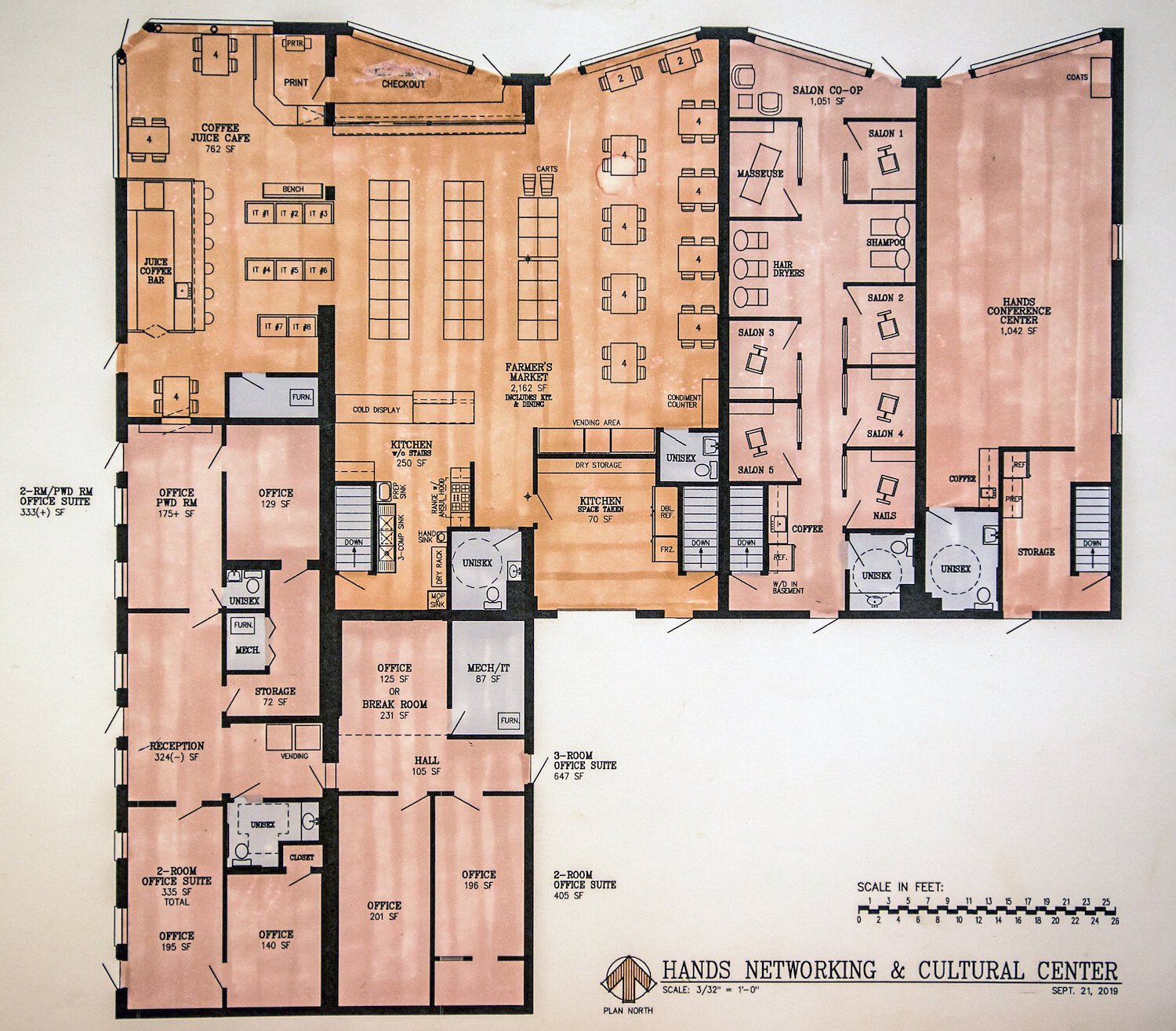
To keep it active throughout the week, the team is collaborating with longstanding Southeast entrepreneur, Veronica Townes, who has owned and operated Optimistics Enterprise Beauty & Barber Salon across the street for 26 years.
With a Ph.D. in cosmetology, Townes teaches at the FWCS Career Academy at Anthis and helps up-and-coming stylists earn experience as part of her beauty incubator program. When the HANDS Center opens, she’ll have a salon next door to it to expand her operations.
“I’m working with them on whatever they need,” Townes says. “I’ve seen people in this building, and they come and go. It will be nice to have a neighbor who has the same interest in investing in this community.”
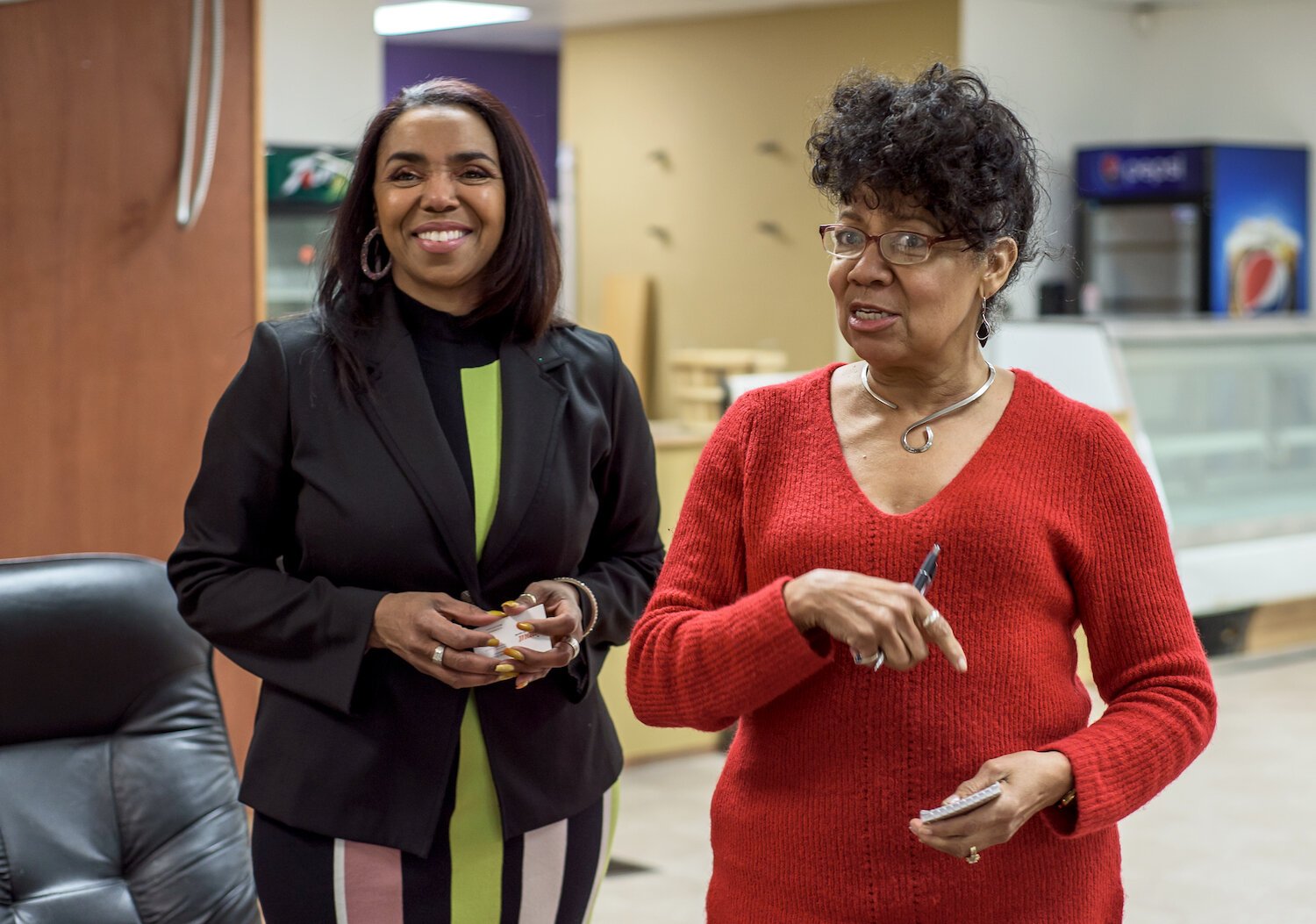
Along with garnering the support of Southeast business owners, the cooperative has a few seasoned members of its own to draw knowledge from, including the mother-son duo, Jain Young and Rowan Greene of the 3 Rivers Food Co-Op and Plowshares Cooperative Food Hub.
“We’ve always loved that community feel with the co-op where its locally owned, and you impact local,” Simmons says. “Our board is interfaith, interracial, and all ages, ranging from 28 up to 80 plus.”
That’s why the grocery is called Utopian Community Grocery, he explains. It’s about creating a shared, community space where everyone can contribute.
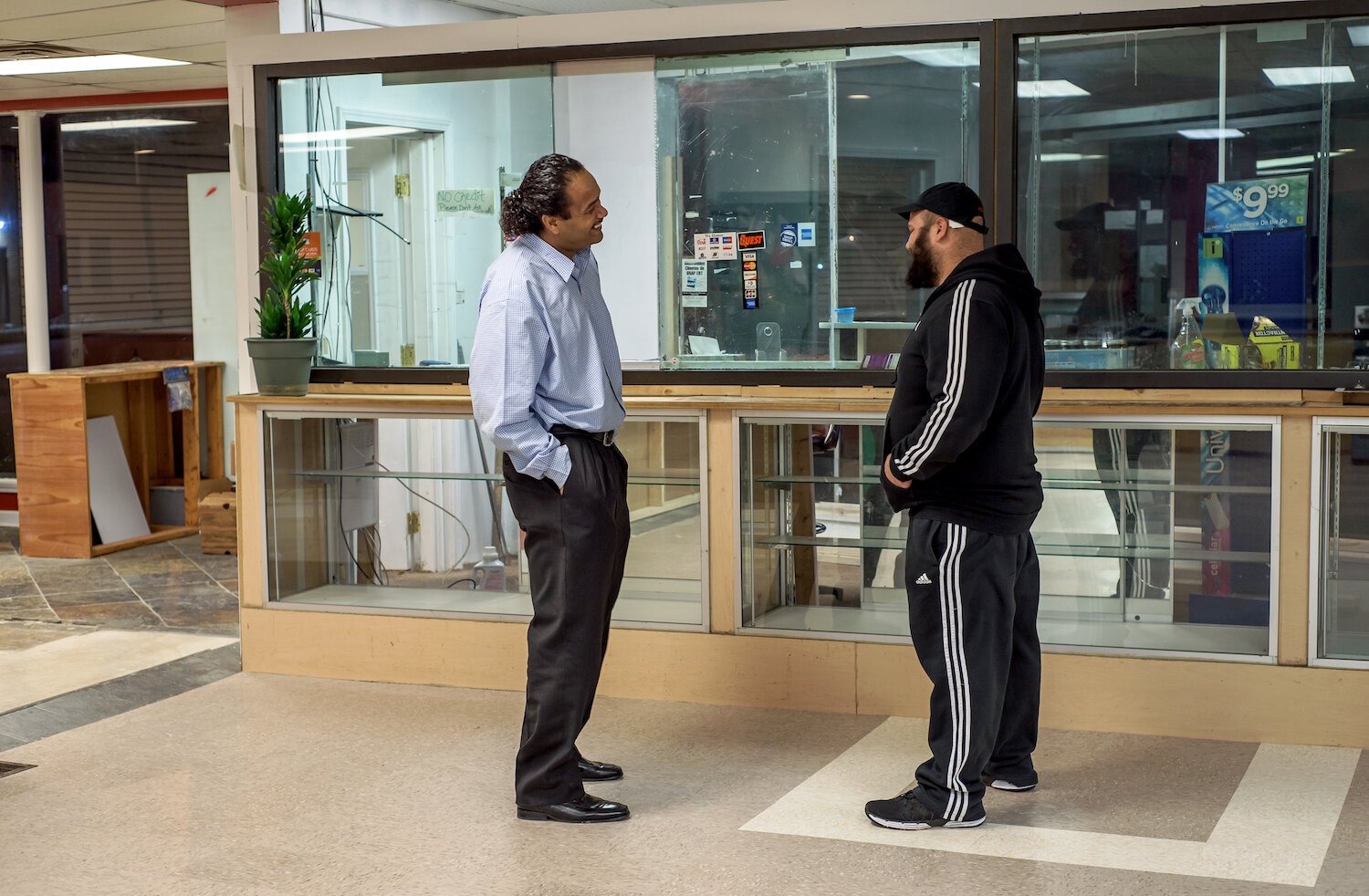
Human Agricultural Cooperative President Michael Reeder is particularly excited about the quality of food that the grocery store will bring to Southeast. It will focus on fresh vegetables, which will be grown by Simmons at an indoor vertical garden or sourced from other local growers, Reeder says. It will also have no red meats—only fish, chicken, and lean meats.
There’s an educational component, as well, he explains. In addition to selling produce and ready-made foods, the market aspires to teach residents how to make healthy versions of family favorites, like Kraft Mac & Cheese, with step-by-step instructions and all of the supplies available for purchase onsite.
“We want to educate you while you’re here, so you can make a better decision every time you shop,” Reeder says.
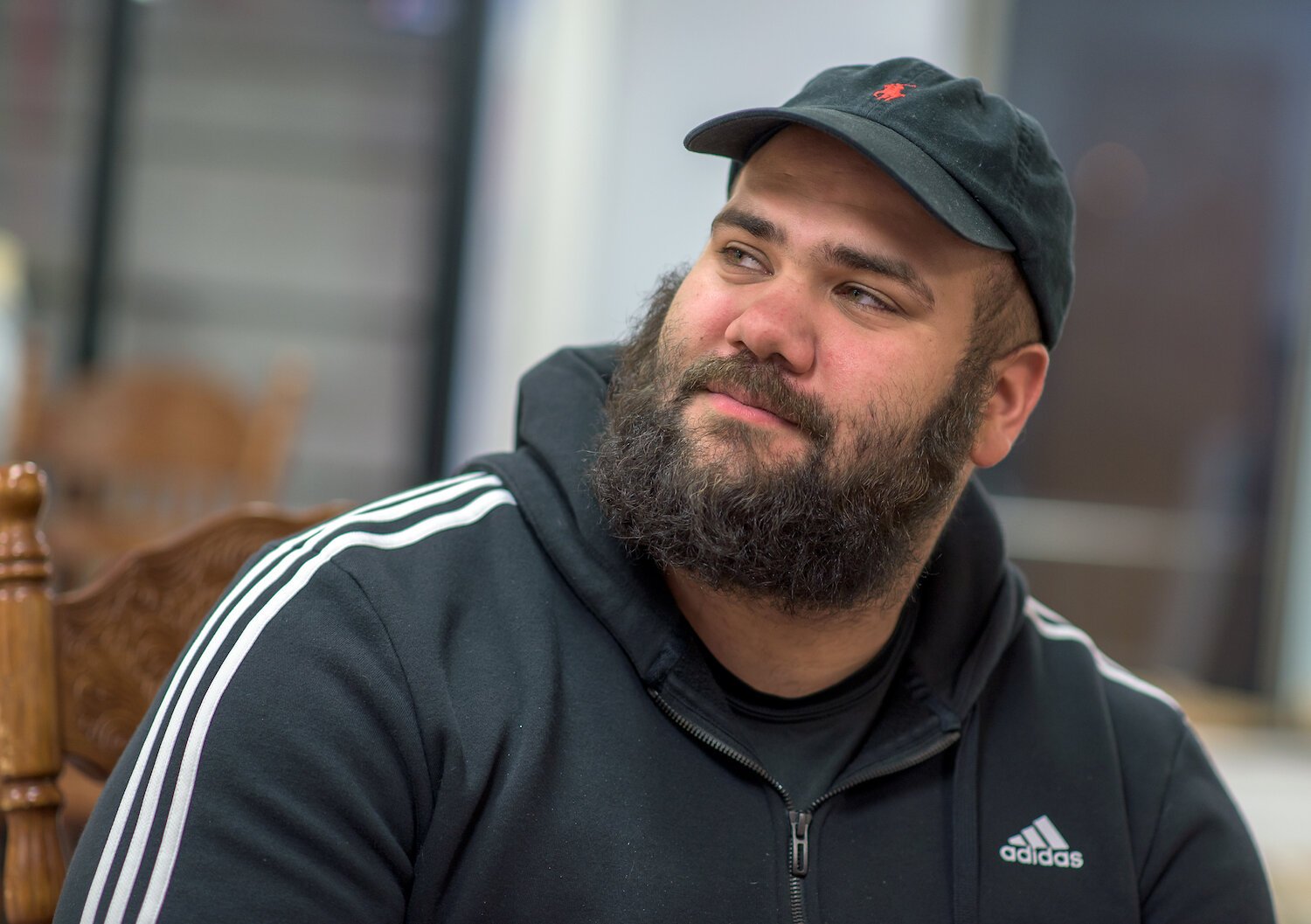
Along with renovating its space, the Human Agricultural Cooperative is currently in the process of fundraising for the project. To make the grocery financially feasible long-term, they have a membership program designed to give individuals and corporations a way to buy into improving food conditions in Southeast and get some healthy groceries themselves at the same time, Simmons explains.
For as little as $5 a month, individuals can get monthly memberships to the Utopian Community Grocery, which give them 10 percent discounts on its products. Annual memberships for corporations range from $1,200 to $5,000, allowing business owners anywhere to incentivize their employees to shop Southeast and uplift the community economically.
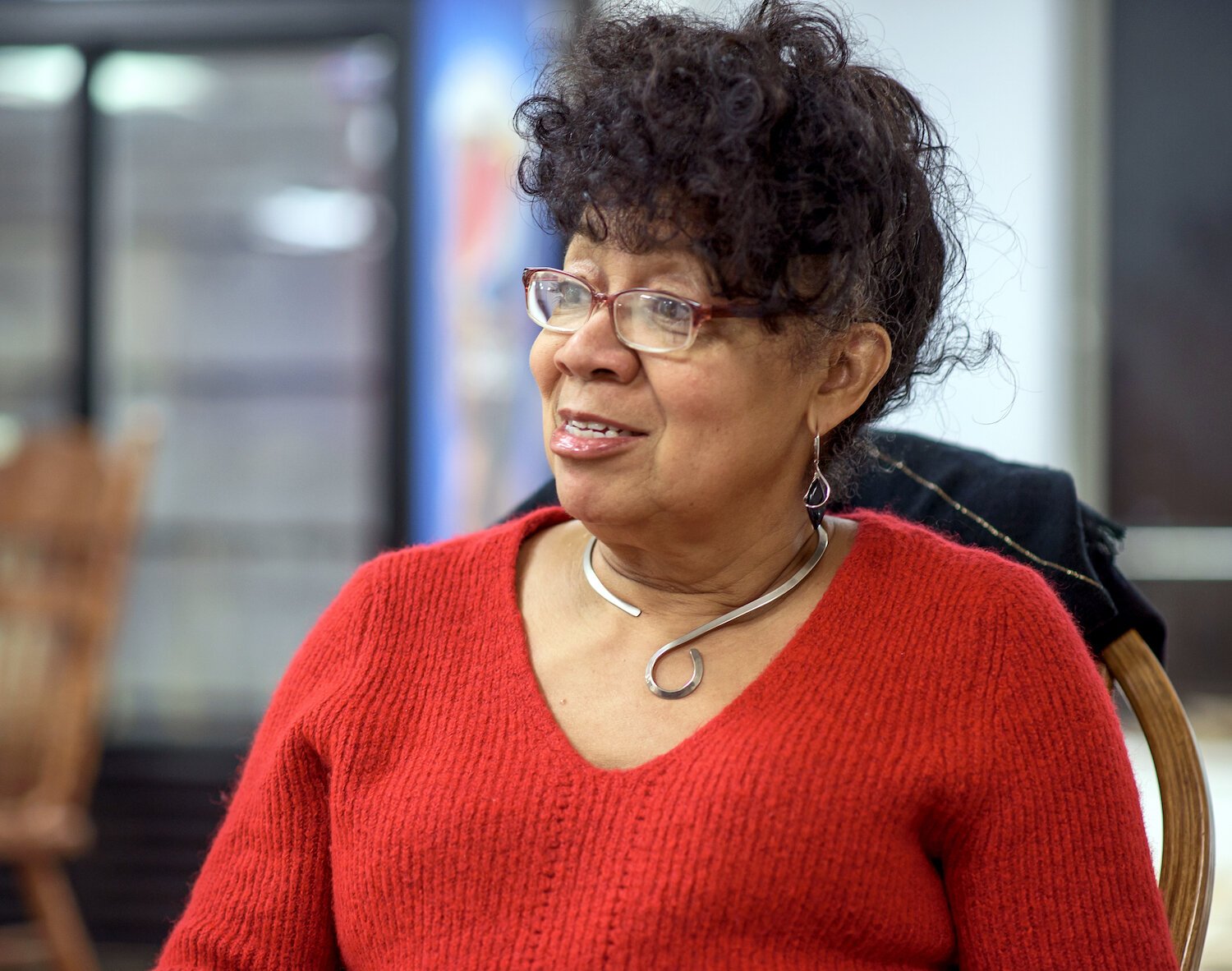
For Human Agricultural Cooperative Vice President, Condra Ridley, creating a welcoming, safe space for everyone is a big part of the equation. Ridley worked as a manager for the Pontiac branch of the Allen County Public Library from 1981-1997 where she began investing in Southeast youth, “impressing on them the importance of developing yourself, so you can contribute something positive to your community,” she says.
She’s excited about the potential of the HANDS Center to be a “third space” for residents to connect and collaborate in ways that will advance their skills and their neighborhood.
“Even if people are just crossing paths, I think a whole lot of really great things are going to come out of the opportunity to have a place to go that’s a neutral, nice, peaceful space,” Ridley says. “We’re talking economic health and physical health.”
If everything goes as planned, the HANDS Center and its grocery store could open as early as the spring of 2020.
Along with developing unique funding models, membership plans, and keeping prices competitive, collaboration is becoming a key factor among all of Fort Wayne’s emerging urban markets. The Utopian Community Grocery is interested in collaborating with other markets around town, too, Ridley says.
“That’s a big part of our mission,” she adds, “to build cooperation instead of competition.”
Ultimately, all of Fort Wayne’s small grocery stores are serving a larger goal, Simmons says. As more of Fort Wayne’s food deserts gain access to affordable, accessible healthy food, more of the city’s residents can rise together.
“It’s just the right time,” he says.
This special report was made possible by Greater Fort Wayne Inc.
Author

Related Articles
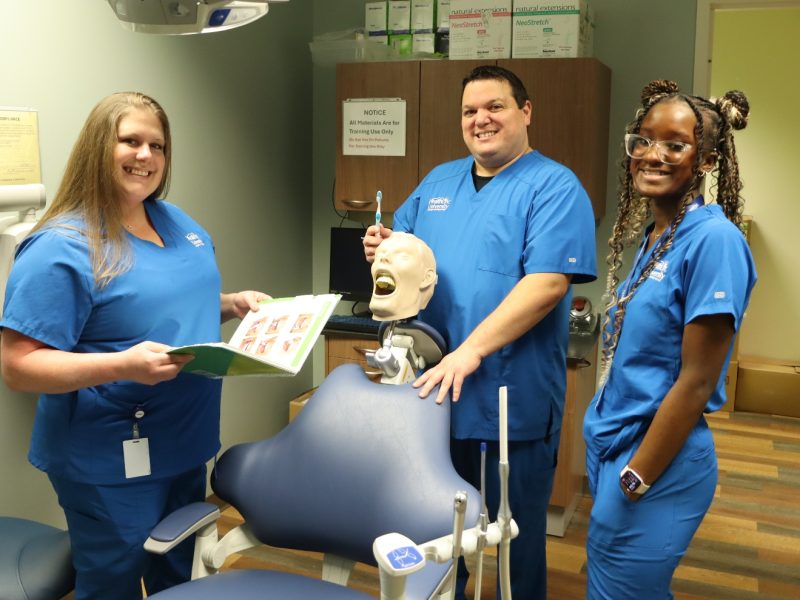
Indiana health center trains local residents as dental assistants to fill workforce gaps
HealthLinc, a federally qualified health center in Valparaiso, covers training costs while preparing local residents for dental assistant jobs, strengthening workforce pipelines and expanding access to care.
What will Dekalb County do with the historic Sunny Meadows property?
Sunny Meadows, a county residential home, is now closed, but the building’s future is up for debate.