SPECIAL REPORT: Where’s the office space? As downtown thrives, Class A office space is limited
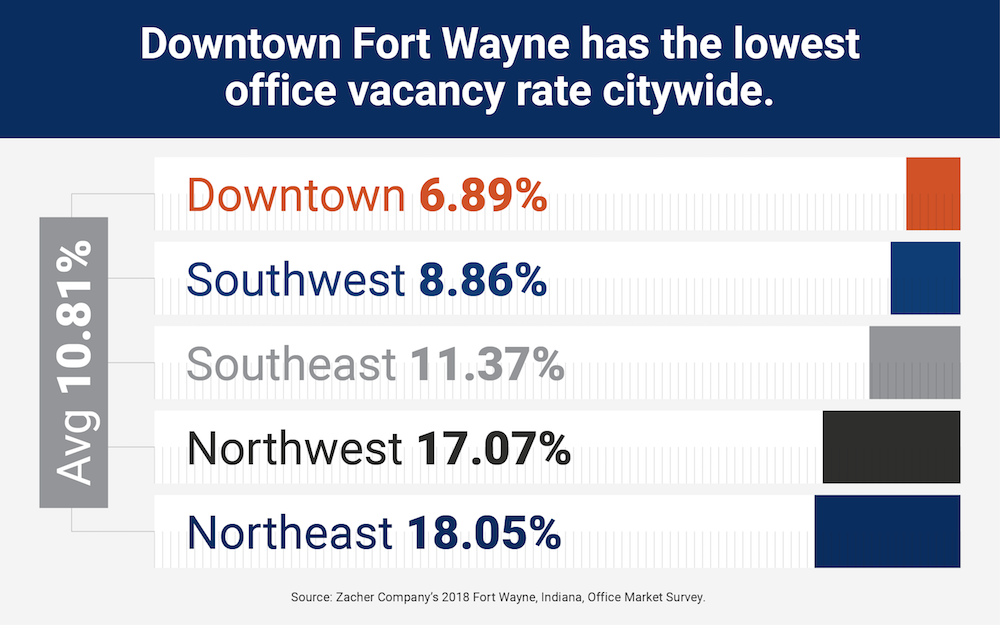
Downtown Fort Wayne has the lowest office vacancy rate in the city, and Class A space is in high demand.
When the Atlanta-based software development company Rural Sourcing was looking to open its sixth office last year, the Summit City was high on its list of prospects for a number of reasons, says CFO Tre Sasser.
First, the area has a concentration of Java and .NET developers, so he knew they would find the talent needed to fill 130 positions.
On top of that, he wanted the company to be in a city with a high quality of life and a low cost of living.
“All of this data pointed us to Fort Wayne,” Sasser says.
When his team arrived for an on-site visit, they were equally encouraged. Across the country, Rural Sourcing likes to plant their offices in urban cores where employees can live within walking distance of work and access amenities, like coffee shops, restaurants, and entertainment nearby. They found all of this in Fort Wayne, too.
“We were particularly impressed with the amount of development happening downtown,” Sasser says. “It’s an exciting time to be in Fort Wayne, and we feel like our timing is very good.”
But when it comes to finding a large, modern office space for a software development company downtown, things get a little trickier.
It’s an issue that John Urbahns, CEO of Greater Fort Wayne Inc., knows well in recruiting national employers like Rural Sourcing to come to town.
While the city’s urban core offers a vibrant scene of new restaurants, retail shops, and living spaces, its options for premium Class A office space are limited.
“What we’re seeing now is that the current office space is being filled up, and there is the need for additional Class A office space downtown,” Urbahns says.
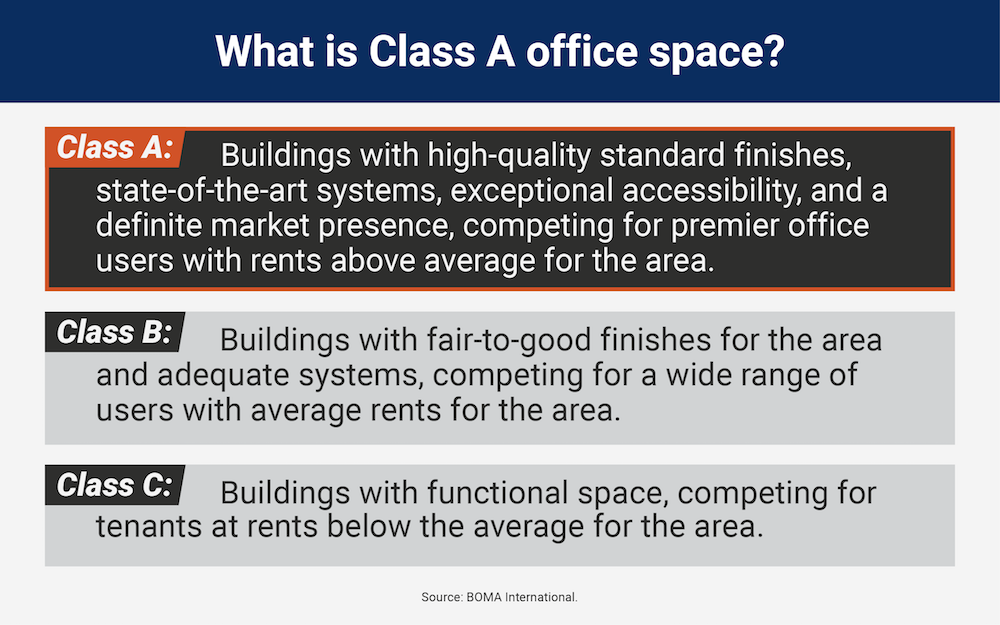
It’s a need that The Zacher Company, a commercial real estate broker in downtown Fort Wayne, has confirmed in its annual Office Market Survey.
For the past 16 years, Zacher has gone through each building in the city, space-by-space, noting its use and vacancy rate, and tracking the changes from year-to-year.
Its most recent survey published in October 2018 found that downtown Fort Wayne has the lowest office vacancy rate in the city at 6.8 percent—down from 18.8 percent in 2009. On top of that, Class A office space (the highest of the three classes) also has the lowest vacancy rate citywide at 9.4 percent.
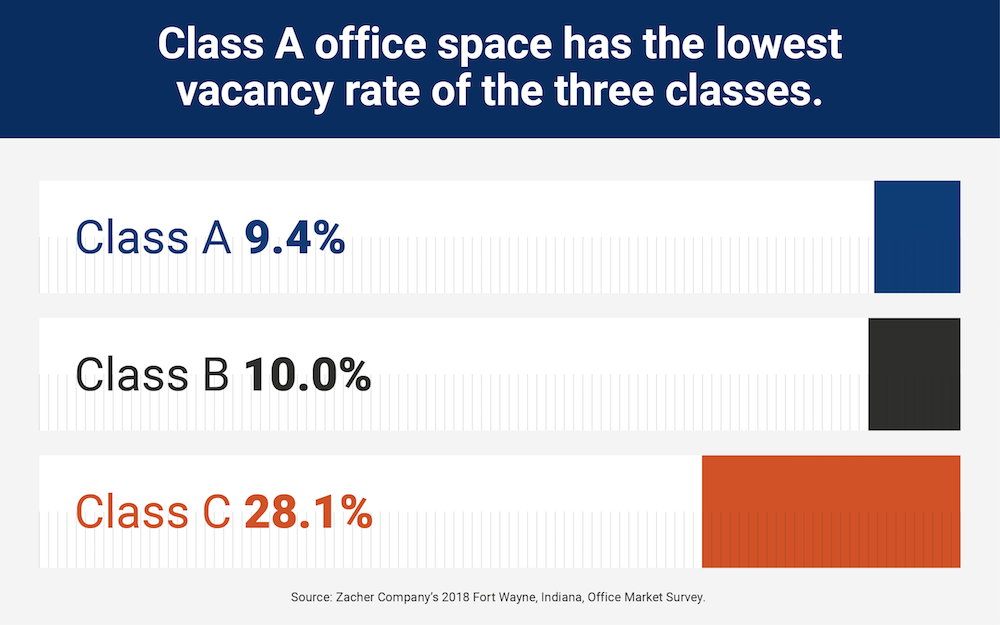
To Steven Zacher, whose firm conducts the study, this means one big thing: Downtown Fort Wayne is ready for more premium office space—whether it happens in renovations or new construction.
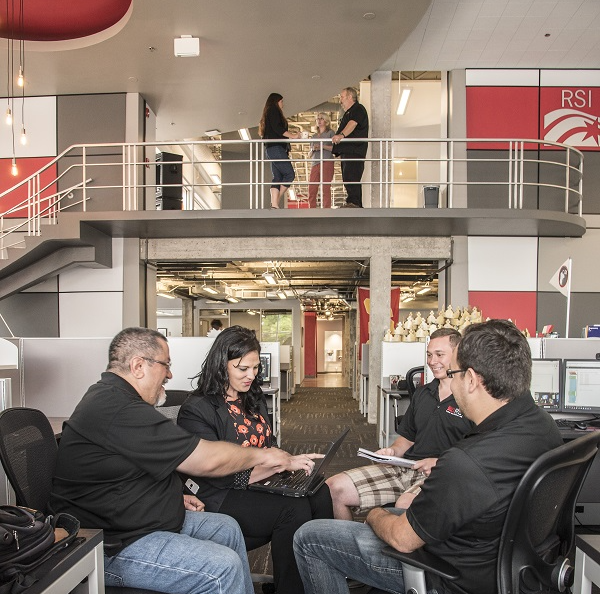
But it’s not just any Class A offices that some innovative, tech-based employers are seeking. Rural Sourcing prefers open, collaborative office environments in historic buildings with compelling stories.
“I’m sitting in a hotel built in 1924 called the Biltmore in Atlanta,” Sasser says. Since 1999, the historic building has been reimagined as Class A office space and condos.
As it stands, historic spaces—and existing spaces, in general—in downtown Fort Wayne are becoming limited, Zacher notes.
From 2017-2018, the city’s 13 million-square-foot office market had a positive absorption of 335,000 square feet of space due to a combination of high demand and limited new construction.
“This is by far the strongest positive absorption since The Zacher Company has been tracking office data in the Fort Wayne Market,” the survey says.
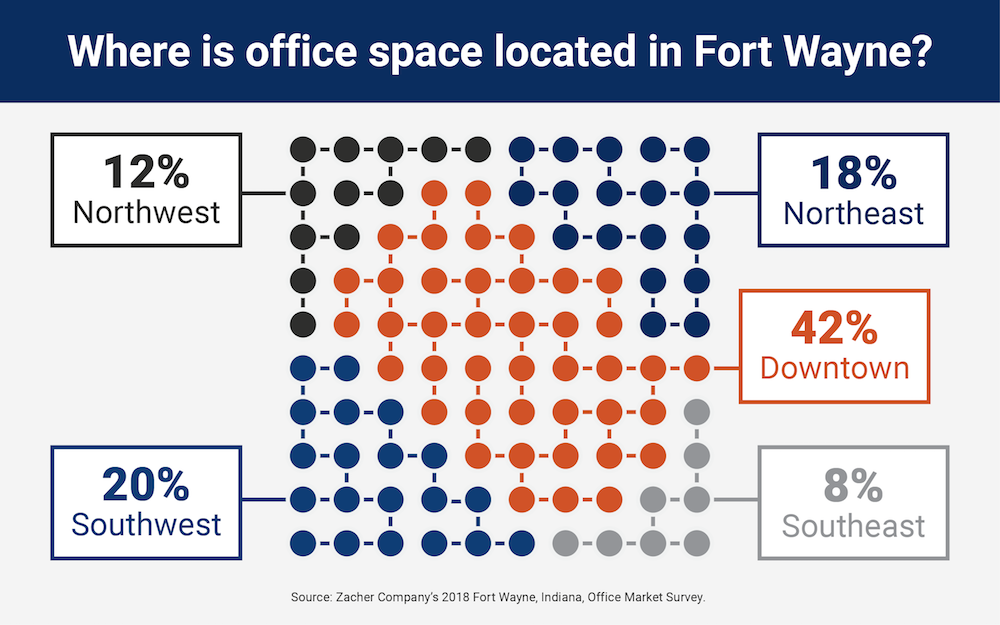
If trends continue, Zacher says it’s likely that new offices being developed as part of projects like Electric Works and Riverfront development will fill up, too.
“The question is: Why can’t we get them built faster?” he says.
For Sasser, that’s the kicker. While he supports efforts to build more dynamic office spaces in the downtown area, he wants to be there sooner rather than later.
He’s planning to put up to 65 employees in a temporary office space on the northwest side of town for six months to a year as he secures and renovates an existing building in the city center.
“We’d like to be downtown as soon as possible,” he says, and he’s not alone in that sentiment—particularly among other tech-based companies relocating to Fort Wayne.
***
Shep and Wendy Moyle own Shindigz, one of the leading party manufacturers and retailers in the country.
“We have 36,000 items we sell in 55 countries around the world,” Shep Moyle says.
For the past 93 years, Shindigz has been based about 40 minutes west of downtown Fort Wayne in South Whitley, Indiana, where it owns two buildings: one for manufacturing party supplies and one that serves as a 68,000-square-foot office for its digital, creative, and management teams.
But while it’s a party company, it’s also a technology company, Moyle notes.
Over the next few years, he’s planning to add 60 jobs in areas like data science and software engineering. To attract and retain this type of high-tech, creative talent, Shindigz decided to sell its South Whitely office and downsize on space to move its office-based employees into downtown Fort Wayne as soon as possible.
“We wanted something unique; we wanted to appeal to young professionals; we wanted to be part of the momentum, and we needed it now,” Moyle says. “Electric Works is really cool, but it’s still two years out, and we couldn’t wait.”
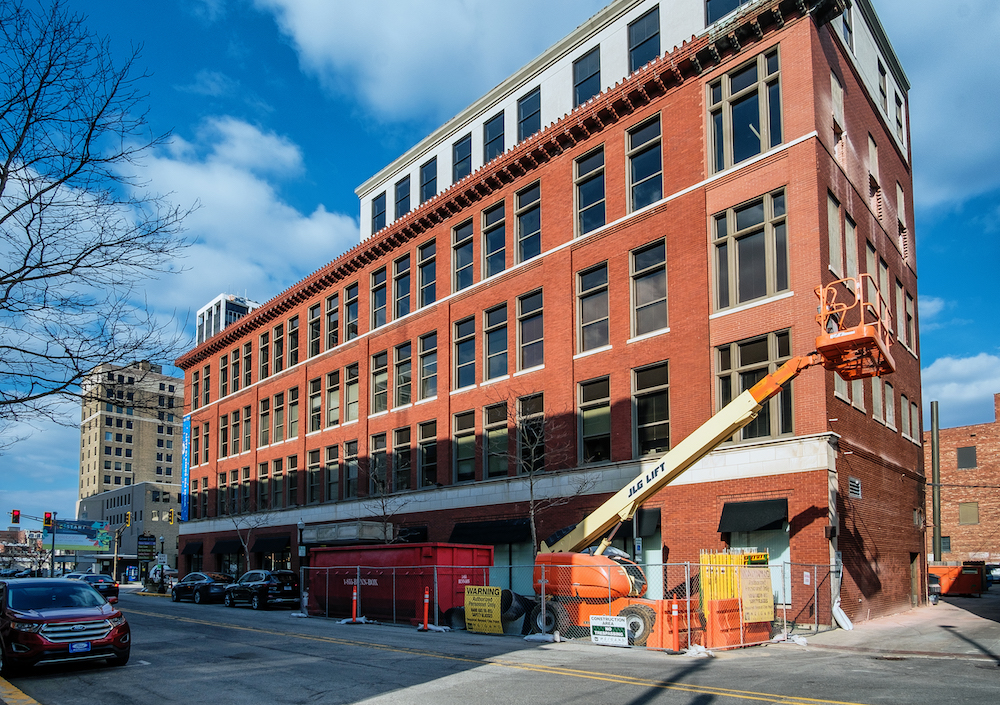
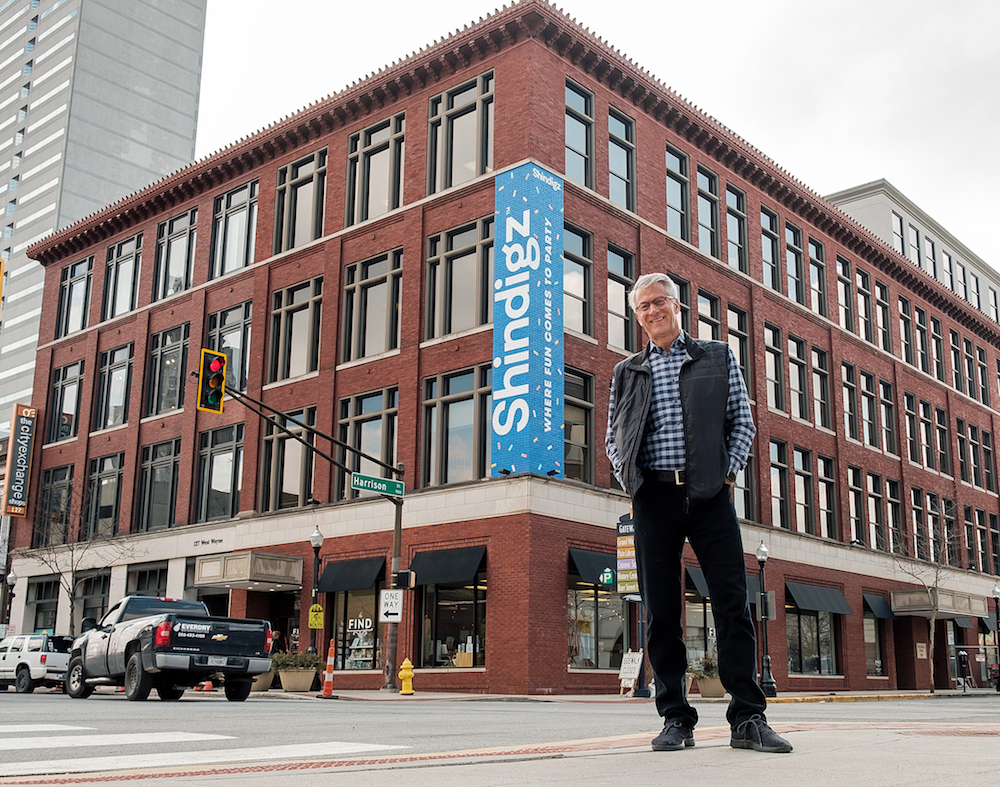
Instead, the Moyles purchased the 33,000-square-foot Harrison Place building at 919 Harrison St. last fall, closing the deal in 48 hours.
Since then, they’ve been renovating the space, knocking down walls on the fourth floor to make an open, collaborative environment for the Shindigz team with exposed brick, natural light, and sweeping views of the city skyline—even a rooftop for celebrations.
The office is expected to open on April 22, when 50 team members will share a roughly 7,000-square-foot space on the fourth floor. Others will be on the third floor, working in a temporary space until it can be renovated. The top floor has a tenant-occupied penthouse, and the ground-level will continue to offer retail space for local businesses, like The Find, Moyle says.
While he admits that purchasing an entire building has been a bold and costly move, he believes it’s worth it for Shindigz to be in Fort Wayne’s urban business core.
Zacher says it’s not too unusual to see business owners like Moyle who are willing to move into smaller spaces to be downtown, as long as they are higher quality or geographically “better” spaces. It’s a trend that Urbahns has noticed, too.
“Class A used to mean marble floors,” he says. “Now, Class A is about location, location, location.”
Ironically, investing in Class A office space in 2019 is often about helping employees spend less time in the office period, Moyle says. As more and more work can be done online, offices are becoming less necessary for employees in all fields—especially tech—he notes.
He sees his building as an attractive “third space” for talent to collaborate as they are out and about in the city’s action.
“I don’t want them staying here and having lunch in this building,” Moyle says. “I want them out there, spinning the economic cycle.”
Companies are sometimes even willing to work in less traditional spaces to get that connected, downtown location they desire. Moyle says Shindigz considered a number of options—renovating gas stations, churches, and factories—before finding Harrison Place.
“You have to try to think creatively about how you can repurpose things,” he says, noting that all potential office space downtown might not be currently classified as “office.”
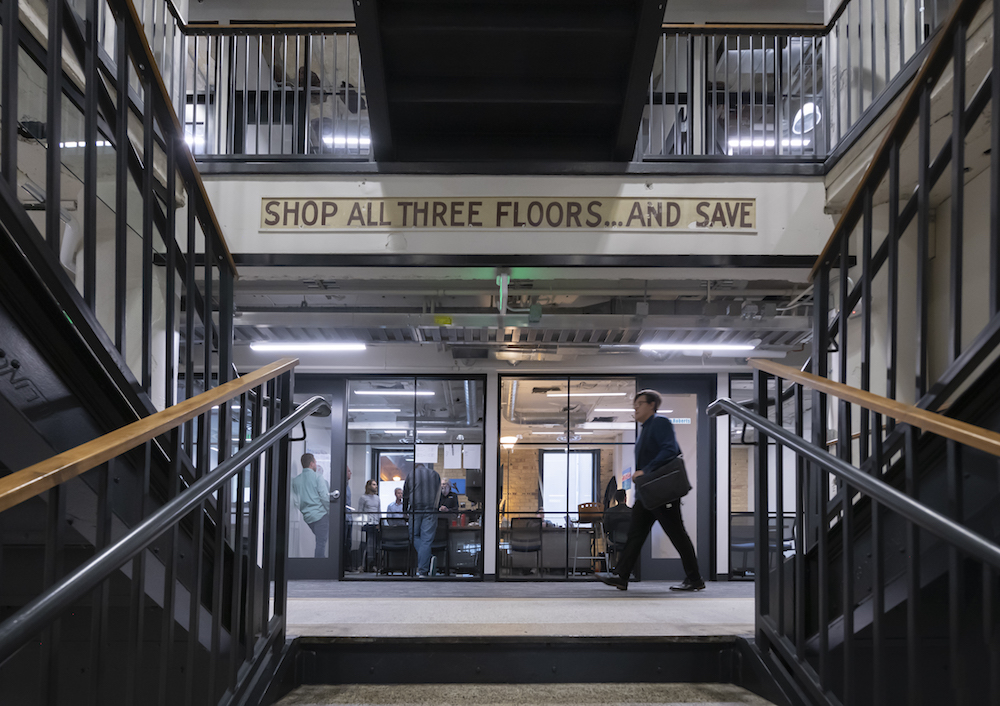
But with a prime location, even unlikely spaces can offer unique benefits.
These benefits are already being enjoyed at places like Aptera down the street—one of the first tech companies to move to downtown Fort Wayne before it was “cool.”
***
The year was 2008 when TK Herman moved his software development company, Aptera, to downtown Fort Wayne.
Parkview Field was under construction, and Herman had a feeling it was going to be a catalyst for the type of talent and culture he wanted to cultivate at his business.
Looking back, he sees it as a providential time, but a stressful one.
“That was our fourth move in five years, so we knew wanted to be done moving for a while,” Herman says, laughing.
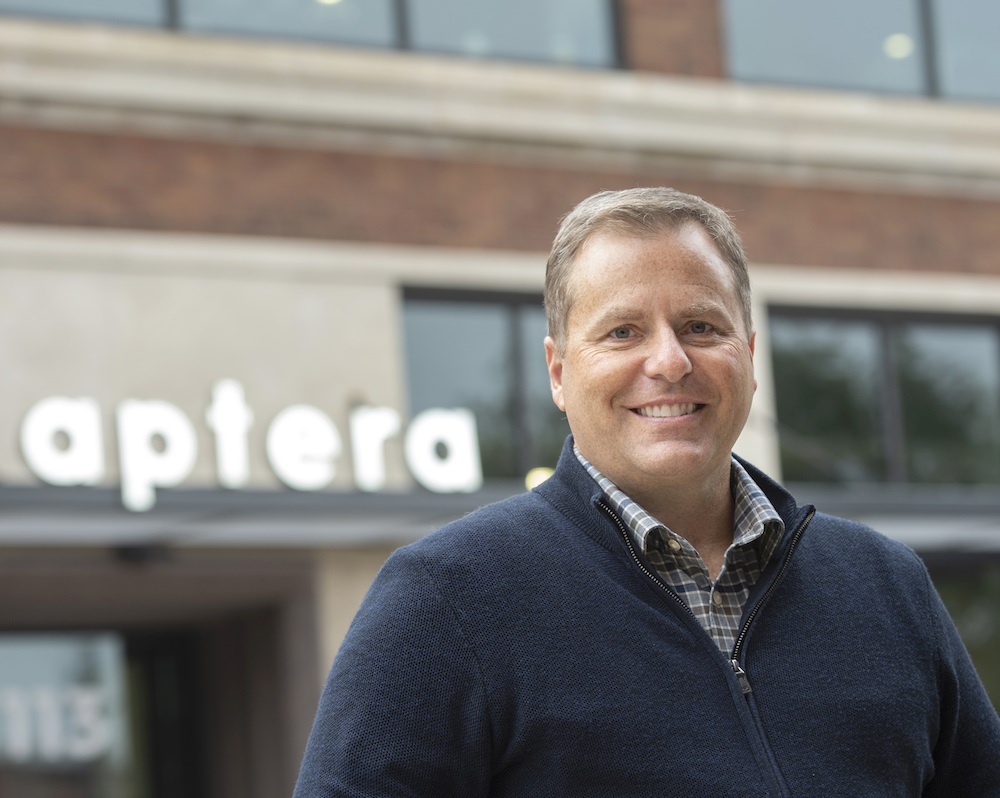
In looking for his first office downtown, he scribbled out a wish list of five things he wanted to find.
First and foremost, he wanted ample room for growth (so they didn’t have to move again). Second, he wanted increased walkability, so people could see Aptera’s signage and stumble upon the company by chance. Third, he wanted prospective clients to be able to walk through the door and feel like it was a “real company.” Fourth, he wanted his employees to walk through the door and have their jaws on the floor. And fifth, he wanted his employees to want to come to work.
He found the space of his dreams at 201 W. Main St. where he grew the company for 10 years.
Then, when they were pushing 90 employees with 20 new jobs on the horizon, he pulled out his old wish list to begin his search again, and he realized he didn’t need to update it.
“I wouldn’t change a thing,” he says.
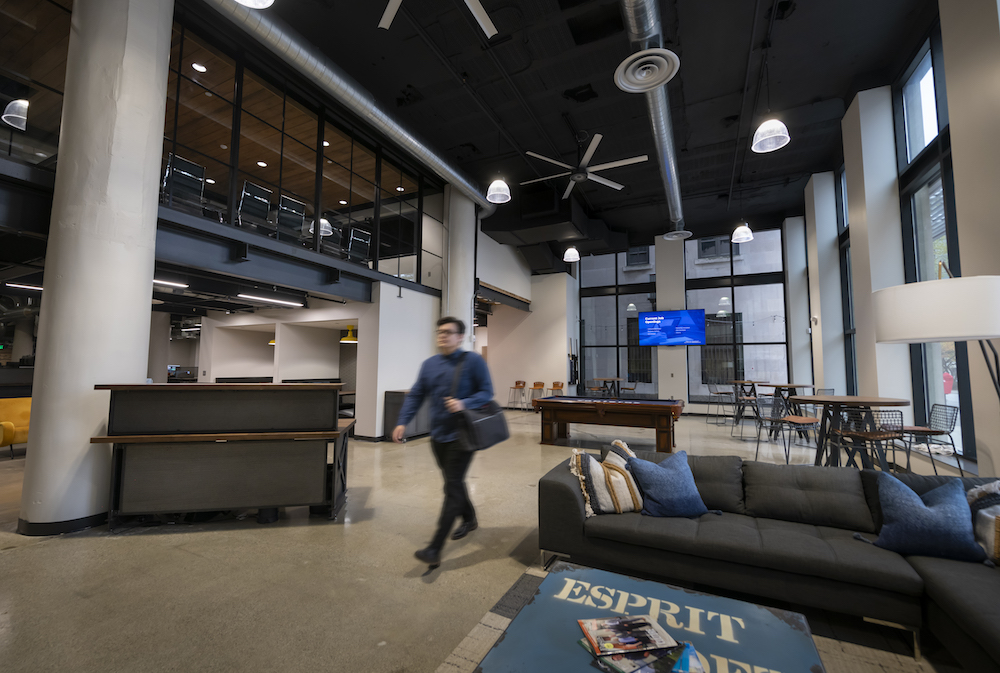
Even so, this time, he was looking for more space downtown and finding it was harder.
Fort Wayne only has six office buildings with 30,000 square feet of contiguous office space in the city, Zacher’s survey notes. Two are in downtown, four are in the suburbs, and none fit Aptera’s desire for a stumble-upon, storefront presence.
Luckily, Herman eventually found a vacant 38,757-square-foot historic building for sale at 113 W. Berry St. and was able to close a deal. He says it took him about a year to get to that point.
Then he spent the next year investing more than $2 million in renovating the space into the office of his dreams with a storefront lobby, pool table, and kitchen where his employees can mingle. In back, there are private offices and communal spaces on the first two floors, as well as the basement. The third floor is unfinished with 9,000 square feet of room to grow.
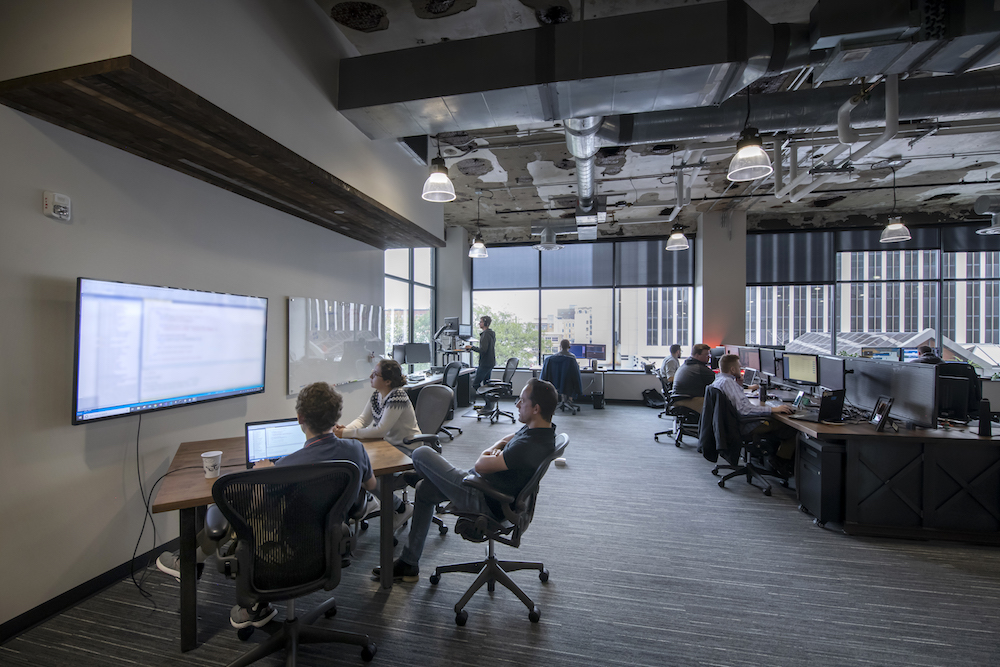
As Herman sees other tech-oriented companies like Shindigz and Rural Sourcing joining him downtown, he says the atmosphere is more exciting than it is competitive.
“It legitimatizes the city for having the talent and the lifestyle that you can attract this many jobs,” he explains.
But each win for a new employer downtown also comes with a cost. As vacancy rates lower, construction costs rise, as do rents, tenant improvement allowances, and parking costs, Zacher notes.
Herman says his staff is already feeling the change from their old office to their new space.
“When we moved, the parking fee literally doubled,” he says. “At our old building, the city owned the parking lot, but the lots we use now are privately owned. That was an eye-opener for us.”
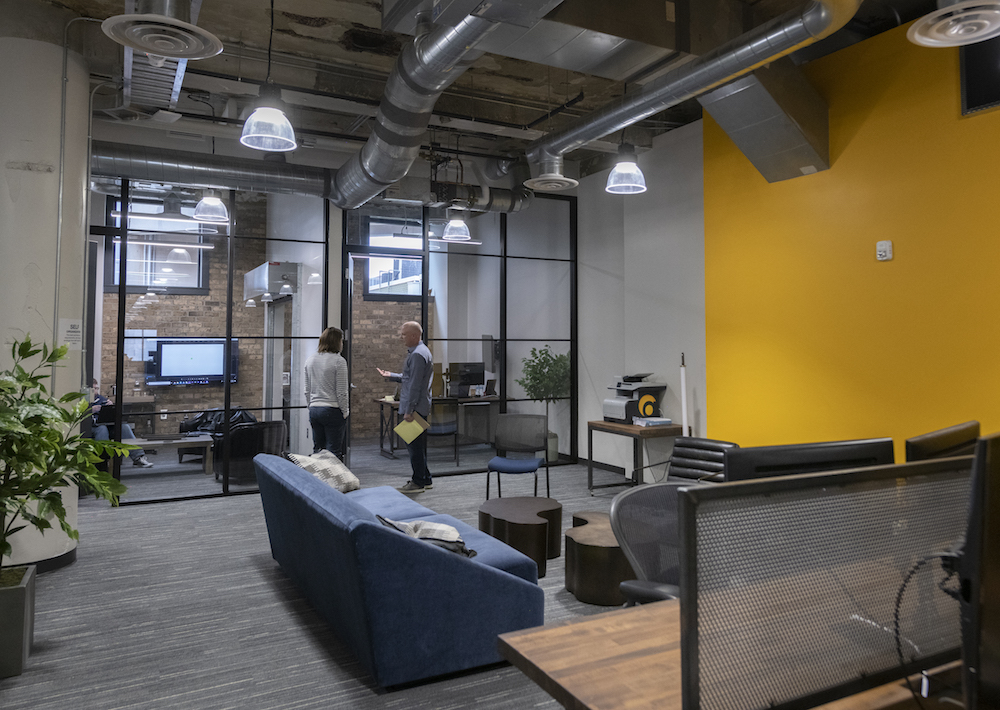
On top of that, he says finding parking spaces for his 90 employees among the city’s many downtown lots was the most complicated part of the process—even harder than historic renovation.
Even so, the prices and inconveniences don’t seem to be preventing employers from wanting to be downtown, Zacher says. If anything, they’re proof that the market is healthy, and business owners are willing to invest in their people.
“Business owners are willing to pay to be downtown because they’re realizing the cost of their people is so much greater than the cost of their real estate,” Zacher says. “An analogy is you pay $30 per square foot for your real estate downtown, but you pay $300 per square foot for your people. If you have a space that your employees are more productive in, if you have collaboration, and healthier, happier employees, then it’s a recruitment and retention tool—especially for higher paying, knowledge-based jobs.”
This Special Report was made possible by Greater Fort Wayne Inc.
Author

Related Articles
What will Dekalb County do with the historic Sunny Meadows property?
Sunny Meadows, a county residential home, is now closed, but the building’s future is up for debate.

#PlacesofNEI: Katey’s Cafe on Berry Street
Katey’s Cafe features a breakfast and lunch menu, as well as a variety of coffees, smoothies and snacks.